African startups raised about $2.45 billion in nine months. A few huge rounds did most of the work, and most founders saw only a small slice.
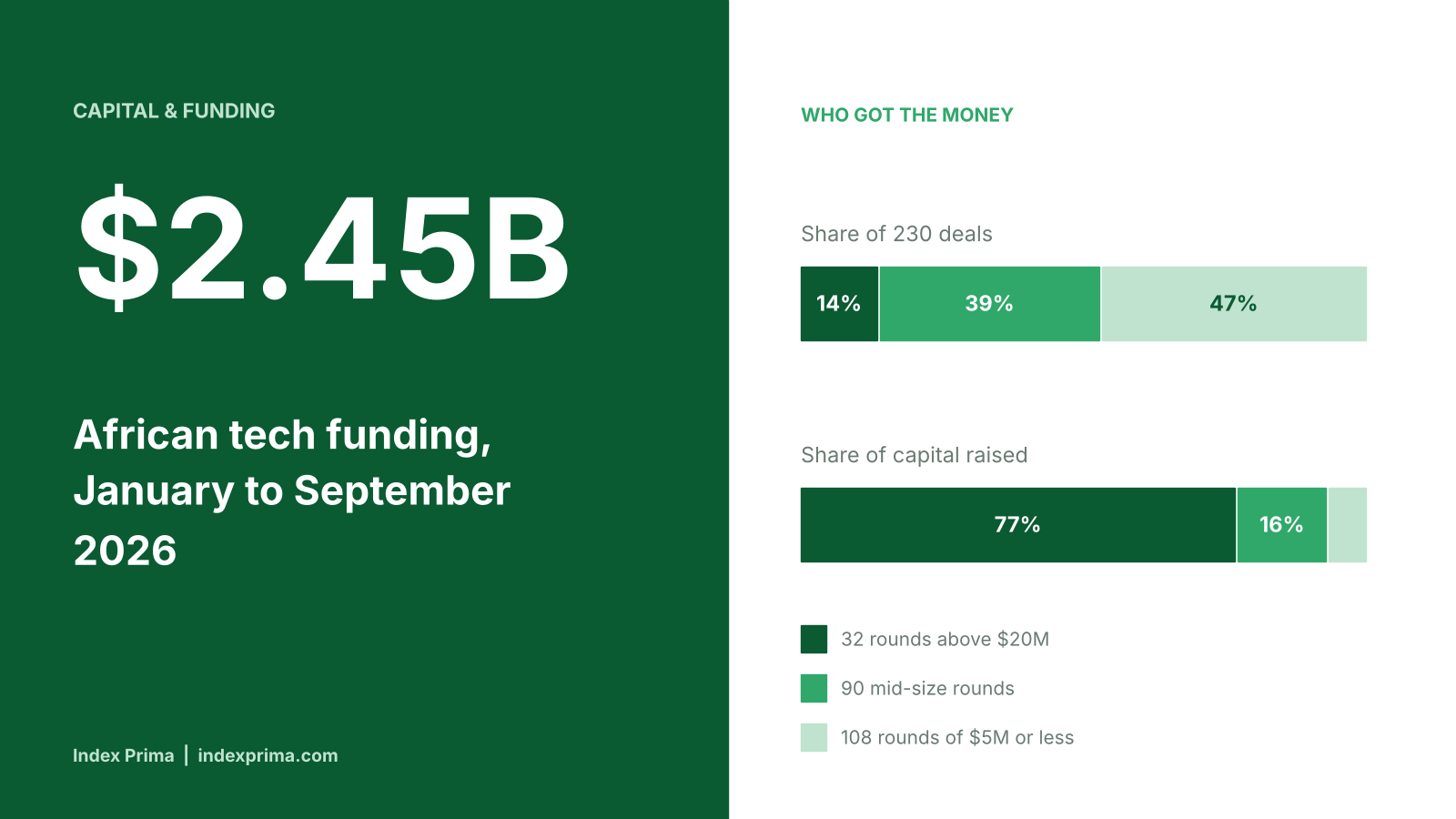
Condia’s funding tracker counts about $2.45 billion in disclosed funding across 230 deals from January to September 2026. Just 32 rounds above $20 million took 77% of the money. The 108 rounds of $5 million or less took about 7%. Debt, electric mobility and a handful of big names shaped the year, while early-stage and software startups faced a tighter market.
Start with the spread. The 32 largest rounds were about 14% of all deals, yet they carried more than three-quarters of the capital. The ten biggest rounds alone made up almost half of the total. At the other end, the 108 smaller rounds were nearly half of all deals. Together they shared about seven cents of every dollar raised. Money is moving, but it is moving to a short list of companies.
Debt is a big reason. Rounds that mixed equity and debt had a median size of $27.85 million. That is about 12 times the median for equity-only rounds. The pattern is strongest in sectors that must buy hardware, such as electric vehicles and clean energy. In July, debt made up $168.55 million, or 75.2%, of the disclosed capital. Equity was $55.51 million, or 24.8%. For firms with steady revenue, debt can be a way to grow without giving up a bigger share of the company.
The full-year picture is less one-sided, though. Africa: The Big Deal, another tracker, puts debt at about $669 million so far in 2026. That is roughly 30% of its total, down from 45% in 2025. It also reports that equity reached $1.5 billion, up 25% on last year. Its Q3 equity of $580 million was the best third quarter for equity since 2021. So debt looms large in some months and sectors, while equity has also come back.
Now the sectors. Logistics and transport led with $780 million, or 36% of the total. Fintech was close behind with $760 million, or 35%. Two companies, Spiro and Moove, raised $595 million between them. That is about 76% of the logistics and transport total. One or two deals can flip a league table.
Spiro shows how this works. The electric motorcycle and battery-swap company raised $215 million in equity in June 2026. About three weeks later, the Chinese early-stage investor NewTrails Capital added $55 million, which lifted the round to $270 million. The money is meant to grow its battery-swap network, strengthen local assembly and open new markets, including the Democratic Republic of Congo and Ethiopia. Spiro also appears among the larger debt deals on The Big Deal’s list, with $50 million.
Moove tells a different story. The Lagos-founded mobility fintech raised a $250 million Series C in August at a $2.1 billion valuation, which made it a unicorn. Tiger Global led. Uber, Mubadala, BlackRock and Prosus Ventures also took part. Moove says it will use the money to scale its autonomous vehicle business, build its AI skills and enter new markets overseas. It now works from an anchor base in the UAE. On 8 October, it also said it would wind down its Nigerian operations and hand vehicles worth about ₦35 billion to eligible customers. The lesson for readers is simple. A company can lift a continent’s funding total without growing most of its business on that continent.
Geography shows the same skew. In Kenya, 73% of disclosed capital went to mobility, mostly because of Spiro’s battery-swap network. Another 17% went to clean tech. Egypt leans on fintech, which took 71% of its capital. Nigeria had the most clean tech deals, with nine, yet raised only $27 million in that sector. Kenya raised $96 million across three deals. South Africa raised $123 million across four. More deals do not always mean more money.
Country rankings depend on who is counting. TechCabal Insights puts Nigeria first at $624 million, followed by Egypt at $396 million, Benin at $345 million and Kenya at $297 million. Another report puts Nigeria at $635 million, about 2.6 times last year’s $247 million.
The totals also differ by tracker. TechCabal Insights counts $2.49 billion across 315 deals, up 7.8% from $2.30 billion a year earlier. The Big Deal counts $2.16 billion, down 4%. Disrupt Africa, which counts startups rather than deals, puts the figure at $1.39 billion for 137 startups. Each tracker sets its own rules on what to include. Read any single number as a guide to the trend, not as a final score.
Terra Industries is the clearest example of fresh capital outside the usual sectors. The Nigerian defence technology company closed its seed round at $52 million after adding $18 million in August. Earlier money came in January ($11.75 million) and February ($22 million). Existing backers 8VC, Silent Ventures, Nova Global, Belief Capital and SV Angel took part. New investors included Norleo Space Investments and the angel investor Grant Gordon.
Nathan Nwachuku and Maxwell Maduka founded Terra in 2024. It makes autonomous drones, interceptor drones, sentry towers and unmanned ground vehicles, all run on its ArtemisOS software. Terra says its systems already protect infrastructure worth about $11 billion in several African countries, such as power plants and mines. It has opened a London office and plans to grow into the Gulf, South America and South Asia. Nwachuku said the funding “puts us in the rooms where global defense decisions are made.”
Manufacturing is the bigger bet. Terra runs a 15,000 square foot site in Abuja called Pax-1. It plans to open Pax-2 in Ghana in the fourth quarter of 2026. At 34,000 square feet, Condia says it is projected to be the largest drone factory on the continent. Terra expects Pax-2 to reach about 50,000 units a year across its aerial systems by 2028. Hitting that goal will take steady supplies of parts and a skilled workforce, both of which vary from market to market.
That is the real test for asset-heavy firms. Import duties, licensing rules and the supply of skilled workers differ across African countries. Companies that cross borders must adapt to each one. Investors will judge these businesses on whether they can deliver on their rollout plans, not only on the size of the cheque.
Meanwhile, the other end of the market is quieter. Early-stage and software-only startups face fewer deals and more careful investors. The money has not left the continent. It is being spent with more care. Founders can expect questions about revenue, traction and the path to profit from the first meeting.
Why it matters: The headline number hides a split market. A small group of asset-heavy firms can raise large equity and debt rounds. Most founders compete for a thin slice of capital. If you are raising, show clear revenue and a credible route to profit. If you are an investor or policymaker, the open question is whether today’s giant rounds will build a wider, stronger ecosystem or deepen the gap.
What to watch next: the full-year 2026 tallies, whether early-stage rounds recover in the fourth quarter, the opening of Terra’s Pax-2 plant in Ghana, Spiro’s push into the DRC and Ethiopia, how Moove’s overseas plans play out, and whether debt keeps gaining share in African startup funding.
Sources: Condia funding tracker, report by Tolulope Bamiloye; Technext on Africa: The Big Deal Q3 2026 data; TechCabal on nine-month funding; bne IntelliNews on Nigeria; Disrupt Africa on Q3 funding; Connecting Africa on Moove’s Series C; Nairametrics on Moove’s Nigeria exit; TechCabal on Spiro’s $55 million; Pulse 2 on Terra Industries.
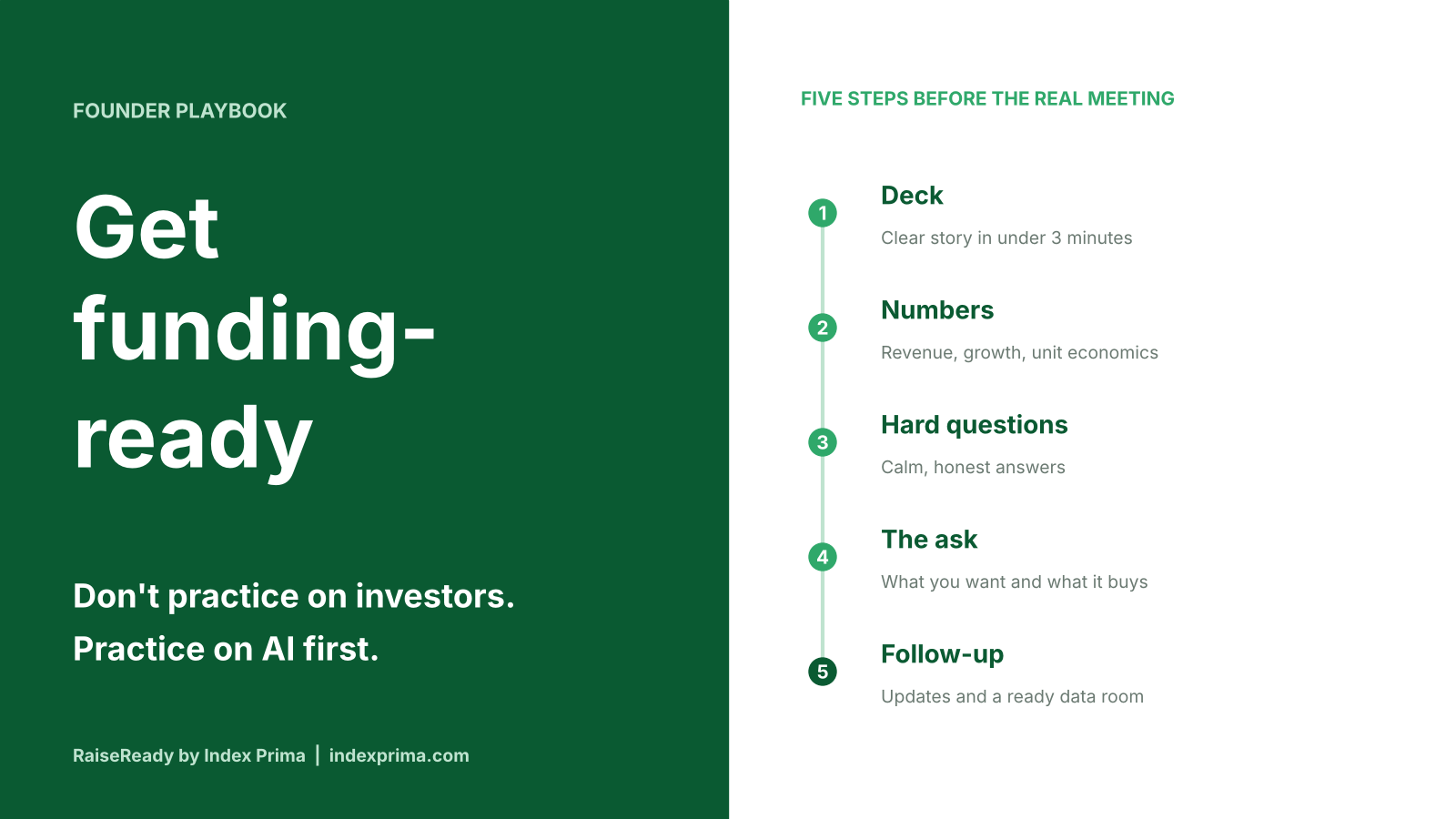
A note for startup founders: Don’t practice on investors. Practice on AI first. RaiseReady by Index Prima is an AI fundraising simulator for African founders: upload your pitch deck, get a readiness score and face a tough AI investor before the real meeting. Find this post, and every post we publish, at raiseready.indexprima.com.