Most pitches are lost long before the investor says no. They are lost in the first few minutes, when the deck is unclear or the answers are shaky. Here is how to fix that before you walk into the room.
Investors across Africa are choosing carefully, so founders must prove more and prepare earlier. A strong deck, clean numbers and calm answers to hard questions can decide who gets a second meeting. RaiseReady by Index Prima is an AI fundraising simulator built for this stage. You upload your pitch deck, get a readiness score and face a tough AI investor before the real meeting. Practice does not replace traction, but it helps you show it well.
Start with the market you are walking into. Condia’s tracker counted about $2.45 billion in African tech funding from January to September 2026. Just 32 rounds above $20 million took 77% of it, while the 108 rounds of $5 million or less shared about 7%. Early-stage founders are competing for a thin slice. Condia also reports that investors are putting weight on established revenue and a clear path to profit.
The gap is real at the early stage. In Tanzania, angel cheques are usually $5,000 to $50,000. Banks reportedly want collateral worth 125% of a loan and three years of audited accounts. That leaves little for founders who need $50,000 to $1 million. Similar squeezes show up elsewhere. In Nigeria, four companies took about 69% of the $635 million raised in the first nine months of 2026, as TechCabal reports.
So what do investors look at first? Your deck. DocSend, which tracks how investors read decks, says investors now spend less than three minutes on one. In its 2020 pre-seed data, decks that raised money held attention for over four minutes, while those that did not got about a minute and a half. Most decks ran about 20 slides with around 50 words each. Those numbers come from older data, so treat them as a guide, not a rule. The lesson holds: a short, clear deck that answers the main questions fast gets more time.
Next comes your reporting. A Wimbart survey of African startups and investors found that 88% of investors use reports when deciding on future investments. Founders said they want a standard format. They also said investors often skip metrics such as customer acquisition cost, lifetime value, retention and churn. Know these numbers cold. If you cannot explain them, practice until you can.
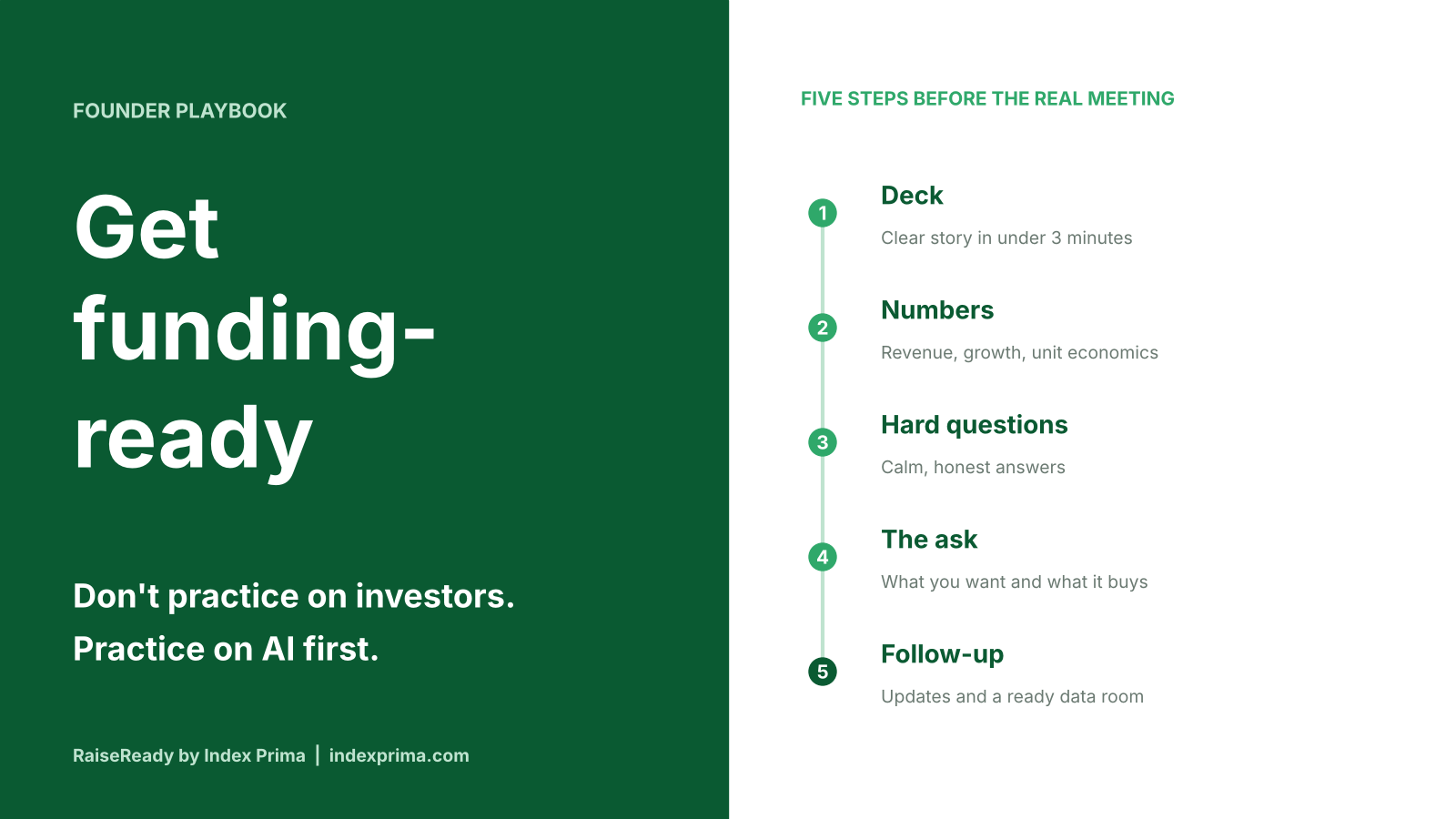
Here is a simple way to prepare, step by step.
| Step | What investors want to see | What to prepare | Where practice helps |
|---|---|---|---|
| 1. Deck | A clear story in under three minutes | About 20 short slides: problem, product, market, traction, team, ask | Upload the deck to RaiseReady and read your readiness score |
| 2. Numbers | Revenue, growth, costs and unit economics | A one-page summary of key metrics, with sources | Rehearse explaining each number aloud |
| 3. Hard questions | Calm, honest answers about risks and competitors | A list of the 10 toughest questions and short answers | Face the AI investor and see where you stumble |
| 4. The ask | How much you want and what it buys | A use-of-funds plan with milestones | Practise defending your ask against a tough investor |
| 5. Follow-up | Updates and proof after the meeting | A data room folder and a simple monthly update | Use what you learned to tighten your answers |
Use the simulator the right way. Run it more than once. After the first round, note the questions that made you hesitate. Fix the deck, tighten your numbers and run it again. Then practise with a friend or mentor so you get used to a real person’s tone. The goal is not to memorise answers. It is to stay clear and calm when the real investor pushes back.
Be honest about the limits. A readiness score does not raise money. Investors still look for real customers, real revenue and a team they trust. RaiseReady helps you present those facts well, and it can show you where your story is weak while you can still change it.
Practice also fits with the other routes open to African founders. Pre-matched investor meetings, such as the Magna Collective drive in Nigeria, reward founders who arrive prepared. Programmes like the African Development Bank’s fund-capacity course and non-dilutive grants such as those from the Founders Support Initiative can add runway while you build proof. Each of them is easier to use when your deck and numbers are in shape.
Why it matters: African startups raise money in a market where a few big rounds dominate and most founders compete for small cheques. Being ready is a real edge. A clear deck, strong numbers and calm answers can turn a short first meeting into a second one. Practising on AI first means your early mistakes happen in private, not in front of investors.
What to watch next: how readiness tools change the way African founders prepare, whether more investors adopt standard reporting formats, and whether early-stage rounds grow again in the fourth quarter.
Sources: Condia funding tracker, as covered by Index Prima; Trendsnafrica on Tanzania’s startup funding; The Rio Times on Tanzania’s funding gap; bne IntelliNews on Nigeria’s nine-month funding; DocSend pitch deck research; TechCabal on Wimbart’s investor report.
A note for startup founders: Don’t practice on investors. Practice on AI first. RaiseReady by Index Prima is an AI fundraising simulator for African founders: upload your pitch deck, get a readiness score and face a tough AI investor before the real meeting. Find this post, and every post we publish, at raiseready.indexprima.com.