Nigeria spent 2026 telling millions of young people to learn a skill. The harder question is how many of them got a job, and who is counting.
Five federal schemes now chase that goal: 3MTT, N-Power, the Nigeria Jubilee Fellows Programme (NJFP), ITF SUPA and the new iDICE skills-to-jobs push. Together they target millions of young Nigerians. The training numbers are big and still growing. The weak spots are placement data, payment reliability and proof that a certificate leads to income. This report looks at what each scheme promised, what it has delivered, and where it fell short.
Start with the problem itself. The National Bureau of Statistics (NBS) put unemployment at 4.3% in the second quarter of 2024. Add people who work too few hours, and the rate rises to 13%. Informal work was 93% of all employment. A separate youth report, presented in Abuja in 2025 by Plan International Nigeria, said nearly 80 million young Nigerians are unemployed. The two sets of figures use different definitions, so they should not be mixed. What they agree on is the pressure. That report adds that about 1.7 million graduates leave universities and polytechnics each year. The economy cannot absorb them all.
3MTT, the 3 Million Technical Talent programme, is the biggest bet. The Federal Ministry of Communications, Innovation and Digital Economy launched it in October 2023. The goal is to train three million Nigerians in digital skills by 2027. More than 1.7 million people applied in the first month. The first cohort of about 30,000 fellows began in December 2023, across all 36 states and the FCT. Later phases added cohorts of 60,000, 90,000 and 120,000.
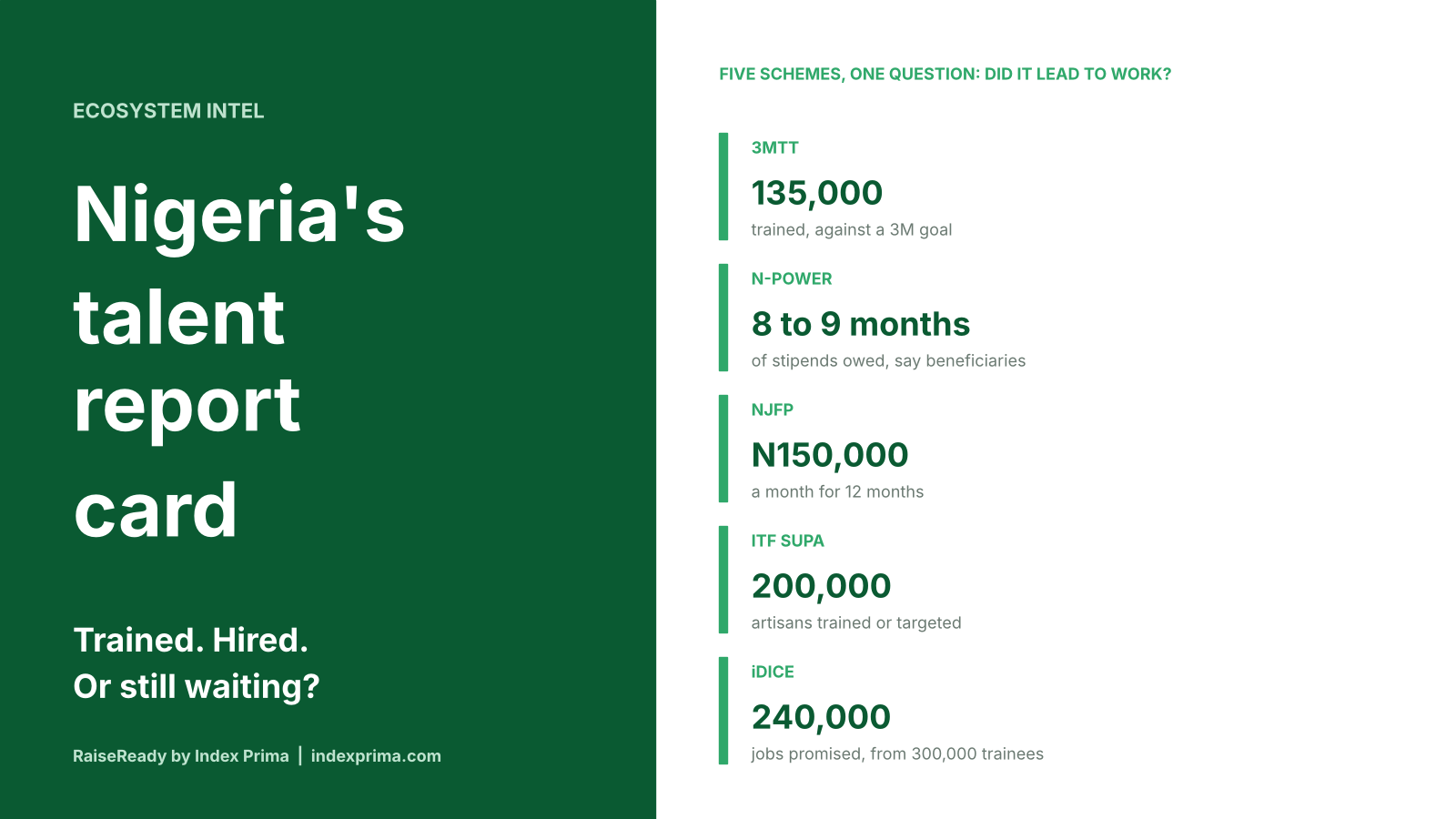
The ministry says the pilot has trained over 135,000 Nigerians across three cohorts. It says community learning reached more than 300,000 people. It also says the programme has created about 15,000 jobs and opportunity pathways. Those words matter. TheRadar notes that “pathways” is not a count of people hired, and the ministry has published no figures for paid internships, full-time hires or remote contracts.
Earlier numbers paint a harder picture. TechCabal reported in 2024 that only about 19% of the first cohort, a little over 6,000 people, finished the course. It put the placement rate for that cohort at 11.21%, or more than 3,500 jobs. In December 2025, educator Alex Onyia said about half of the first cohort had withdrawn. He blamed a shortage of laptops, saying fewer than 1,000 were handed out to 30,000 fellows. His figures came from his own survey of 50 participants and a post on X, not from an official count. Still, they point to a real problem. A course taken on a phone with weak internet is hard to finish.
Money has also been tight. The ministry’s 2024 budget was N28.54 billion, and total costs were estimated at over $30 million across four years. Private partners stepped in. IHS Towers committed N1 billion. About N5 billion in device financing was arranged through Rayda and The Alternative Bank. At a December 2024 summit, IHS, MTN and Airtel pledged more. Learning partners were paid N20,000 per fellow, but some say the first cohort’s payments came months after it ended.
The published numbers also do not line up. Cohort plans add up to hundreds of thousands of seats, while the trained figure stands at 135,000. The ministry has not explained the gap in public. In January 2026 it launched an Impact Challenge, asking fellows to share career stories on social media for prizes such as laptops and data. Success stories are welcome, but they are not data. To its credit, the move shows the ministry knows it must shift from counting enrolment to tracking outcomes.
There are real wins. The 3MTT-NJFP placement initiative, run with the EU and UNDP, lets employers hire pre-screened digital talent at no cost. A July 2025 career fair with Microsoft brought fellows face to face with recruiters. It also reached all 36 states and the FCT from its first cohort, well beyond Lagos and Abuja.
N-Power is the oldest scheme and the clearest warning. Launched in 2016, it placed graduates and non-graduates in teaching, health, agriculture and tech roles for a monthly stipend of N30,000. In 2023 the programme was suspended for restructuring and a forensic audit. Officials promised nine months of arrears in instalments. They said the scheme would continue as the Renewed Hope Job Creation Programme, aiming for five million beneficiaries over five years.
Beneficiaries say the promise has not been kept. On 4 February 2026 they marched on the National Assembly and the Finance Ministry in Abuja. Their placards read “They Worked, Pay Them.” They say they went unpaid from October 2022 to September 2023. Some sued the federal government at the National Industrial Court in 2025. In July 2026 a South-East coordinator wrote to Imo State Governor Hope Uzodimma, saying thousands are still owed eight to nine months. SaharaReporters carried no official reply to the protest or the letter. The scheme has also faced claims of ghost beneficiaries and bribes to stay on the payroll. A stipend programme lives or dies on one thing: paying people on time.
The Nigeria Jubilee Fellows Programme takes a tighter approach. It began in 2022 and gave paid fellowships to over 14,000 graduates in its first phase. The second phase opened in October 2025 with a goal of 20,000 jobs a year. Only about 5% of applicants are admitted, after aptitude tests and video assessments. Fellows get N150,000 a month for 12 months, paid by UNDP with the EU and the federal government. Employers pay no salary, but they must confirm attendance each month, and UNDP runs surprise checks. In June 2026 the Abuja job fair drew more than 500 employers and about 1,500 young professionals. Officials expect fellows to find jobs, though the placement number has not been published. A basket fund is planned to keep the scheme alive after EU support ends.
ITF SUPA, the Industrial Training Fund’s Skill Up Artisans programme, targets the trades. In July 2026 the ITF set a first-phase goal of at least 200,000 artisans, and the federal government set aside N3.6 billion for tailors. The fund is screening applicants, because some people allegedly posed as artisans to collect stipends without training. It has also scrapped the old starter pack after beneficiaries sold their equipment. In its place come industrial sewing machines, tools and follow-up support. Trained artisans will be certified, listed on a digital marketplace and open to customer ratings.
By October, Director-General Afiz Ogun told the National Industrial Manpower Summit that over 200,000 artisans have been trained under SUPA. It is not clear whether that counts only 2026 or every year of the scheme. He said 9,000 artisans had sat international exams set by bodies such as City & Guilds and the National Open College Network. Nigeria also became the 89th member of WorldSkills International. Ogun himself called for credible ways to measure progress.
iDICE is the newest and biggest on paper. Announced on 29 September 2026, its skills-to-jobs strand aims to train and connect 300,000 Nigerians aged 15 to 35. It sits inside the $617.7 million iDICE programme. Backers are the African Development Bank, Agence Française de Développement and the Islamic Development Bank. The Bank of Industry co-funds it and runs it. Six implementing partners, one per geopolitical zone, will deliver basic, intermediate and advanced tracks online and in person. At least 40% of places go to women, and at least 5% to people with disabilities or young people outside work and school. The headline promise is an employment link rate of at least 80%, which means jobs for 240,000 people. No start date has been given. That target is bold. 3MTT’s first cohort reported a placement rate of 11.21%.
| Programme | Run by | Aim | Reported result | Biggest gap |
|---|---|---|---|---|
| 3MTT. | Communications ministry. | 3 million by 2027. | 135,000 trained. | Placement data. |
| N-Power. | Social investment office. | 5 million in 5 years. | Not reported. | Unpaid stipends. |
| NJFP. | UNDP, EU, FG. | 20,000 jobs a year. | 14,000 in phase one. | Hiring numbers. |
| ITF SUPA. | Industrial Training Fund. | 200,000 artisans. | 200,000 trained. | Unclear scope. |
| iDICE. | Bank of Industry. | 300,000, 80% hired. | Just launched. | No start date. |
Other efforts add to the mix. A N158 billion Youth Empowerment Programme, announced in September 2025, aims to train 650,000 people in technical, vocational and digital skills. In the private sector, Aboyeji’s Learn2Earn drew over 63,000 applications and admitted about 1,400 fellows.
Why it matters: Nigeria has built the front door to skills training. It has not yet proven the back door to work. The same lessons repeat across schemes. Publish completion and placement figures. Pay stipends on time. Give trainees the tools to learn. Tie courses to real employers. NJFP’s employer checks and SUPA’s certification show better design. Success should be measured in incomes and jobs held after a year, not seats filled. For African founders and investors, the stakes are high. The talent these programmes produce is the hiring pool of the next decade, and a trained but unemployed generation helps no one.
What to watch next: whether the ministry publishes cohort-level completion and placement data for 3MTT. Also watch whether N-Power arrears are cleared, how many NJFP fellows land jobs, and whether iDICE shares a start date and its first results. Another test is whether these programmes survive the next change of government, since N-Power alone has passed through several ministers.
Sources: Condia on the 3MTT Impact Challenge; Techsoma on 3MTT; TechCabal on 3MTT’s design and early outcomes; Technext on the first cohort dropout claim; TheRadar on 3MTT and jobs; SaharaReporters on the February 2026 N-Power protest; SaharaReporters on the July 2026 N-Power letter; The Guardian on N-Power arrears; Legit.ng on the N-Power restructuring; Ecofin Agency on the Jubilee Fellows Programme; Authority on the NJFP 2.0 job fair; NAN on ITF SUPA 2026; Roving Reporters on ITF SUPA progress; BellaNaija on iDICE skills-to-jobs; Nigeria Education News on iDICE; Premium Times on the State of the Nigerian Youth Report; NBS Labour Force Report, Q2 2024; Billionaires Africa on Learn2Earn and Talent Nation.
A note for startup founders: Don’t practice on investors. Practice on AI first. RaiseReady by Index Prima is an AI fundraising simulator for African founders: upload your pitch deck, get a readiness score and face a tough AI investor before the real meeting. Find this post, and every post we publish, at raiseready.indexprima.com.