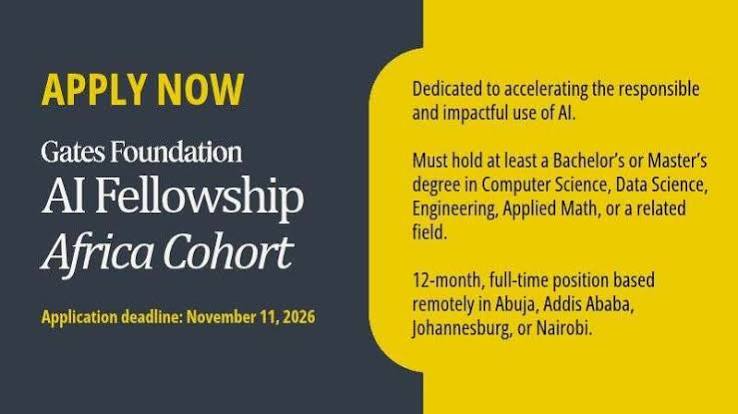
The Gates Foundation wants early-career AI professionals to build health and development tools from inside its Africa team, in Abuja, Addis Ababa, Johannesburg and Nairobi. Applications for the first Africa cohort close on Wednesday 11 November.
The AI Fellows programme is a 12-month, full-time role. Fellows join the foundation’s regional offices, work with its teams, partners and government counterparts, and prototype responsible AI tools for health and development across Sub-Saharan Africa. You need a degree in a technical field, at least two years of applied AI experience and the legal right to work in the country where you apply. The foundation does not sponsor visas or pay for relocation.
The job is called AI Fellow, Africa Regional Offices. It sits on the foundation’s Innovation and Knowledge Management team. The fellow works with the Africa team and with other divisions, including Global Health, Gender Equality, Global Development, and Global Growth and Opportunity. Here is the posting at a glance.
| Detail | What the posting says |
|---|---|
| Role. | AI Fellow, Africa Regional Offices. |
| Length. | 12 months, full time. |
| Bases. | Abuja, Addis Ababa, Johannesburg or Nairobi. |
| Apply by. | 11 November 2026. |
| Degree. | Bachelor’s or master’s in computer science, data science, engineering, applied maths or a related field. |
| Experience. | At least 2 years applying AI, ideally in health or farming systems. |
| Work rights. | You must already be allowed to work in your chosen country. |
| Pay. | Not listed. |
| Benefits. | Health, dental and vision cover with no premiums, paid leave, paid family leave and a retirement contribution. |
What would a fellow do? The posting says they will scope AI solutions with the Africa team and project sponsors. They will build quick prototypes with large language models and other AI tools, then design, test and deploy models and the data pipelines behind them. They will also write reliable software, run workshops and coach staff on using AI responsibly in low and middle income countries. Fairness, bias checks, data privacy and clear explanations are meant to be built in from the start.
The sample projects are down to earth. One is a decision tool that pulls together the systems that track health financing. Another aims to cut stockouts of essential medicines at district and facility level. A third would rank health measures against budget limits and forecast the risk of running short. These are budgets, supply chains and health data, not flashy demos. The posting asks for people who care about health systems, public financial management and supply chains.
This is the first Africa cohort of a programme that began in the United States. The foundation launched its AI Fellows in 2025, with fellows working from home in the US or at its Seattle headquarters. It said it hoped later cohorts would work across its global offices. Now the Africa team is recruiting its own.
The hire fits a bigger push. In January, the foundation and OpenAI announced Horizon1000, a $50 million effort to bring AI tools to 1,000 primary health clinics and their communities by 2028. It starts in Rwanda. The tools are meant to help health workers with paperwork and clinical guidelines, not replace them, in a region short of roughly six million trained health professionals. In April 2025, the foundation also put $7.5 million over three years into an AI Scaling Hub in Rwanda. AI hubs now run in Rwanda and Senegal, and talks are under way in Kenya. Earlier this year, the foundation also advertised for a deputy director to lead its AI work across Africa.
How do you apply? Applications go through the foundation’s careers site on Workday. The posting asks you to apply by 11 November to be considered for the Africa cohort. Employment depends on a background check. Anyone who needs an adjustment during the process can email HR@gatesfoundation.org and quote the position number. If you live in another African country, check the work permit rule first, since the foundation will not sponsor a visa.
If you apply, lead with proof. Show a prototype you built with a large language model, how you tested it and what you did about bias and privacy. Add one example from health, farming or public finance if you have it. Show, too, that you can explain your work to people who are not engineers. That matches what the posting asks for.
Why it matters: Few roles let African engineers work on the continent’s biggest health and development problems from inside a global funder. A fellowship based in Abuja, Addis Ababa, Johannesburg or Nairobi puts them close to the health ministries and budgets where AI tools succeed or fail. The posting also shows what funders now want: not only people who can build models, but people who can test for bias, protect data, write solid code and teach others. Founders and builders can read it as a checklist for what “responsible AI” means to a major health funder, and shape their own products and pitches to match. And for those who cannot apply because of the work permit rule or the location, the wider message holds. The demand is for people who can ship a working prototype and show that it helps.
What to watch next: who the foundation picks, and how many fellows it takes, which the posting does not say. Watch whether later cohorts add more locations, such as Senegal, where the foundation has an office and an AI hub. Watch what the fellows build, and whether their prototypes reach ministries and clinics. Watch how Horizon1000 fares in Rwanda, including the questions critics raise about power, internet and who pays for the tools once the first funding ends. And watch whether future calls share more about pay.
Sources: Gates Foundation careers site, call for applications for AI Fellows, Africa Regional Offices; MyJobMag listing for the AI Fellow role; UNJobNet copy of the posting; EdTech Innovation Hub on the launch of the AI Fellows programme; OpenAI on Horizon1000; Nairametrics on the Gates Foundation and OpenAI partnership; Semafor on the $50M AI health programme; Devex on the Rwanda AI Scaling Hub; Africa.com on the foundation’s Africa commitments; NextBillion on the Deputy Director, AI Delivery and Government Partnerships role.
A note for startup founders: Don’t practice on investors. Practice on AI first. RaiseReady by Index Prima is an AI fundraising simulator for African founders: upload your pitch deck, get a readiness score and face a tough AI investor before the real meeting. Find this post, and every post we publish, at raiseready.indexprima.com.