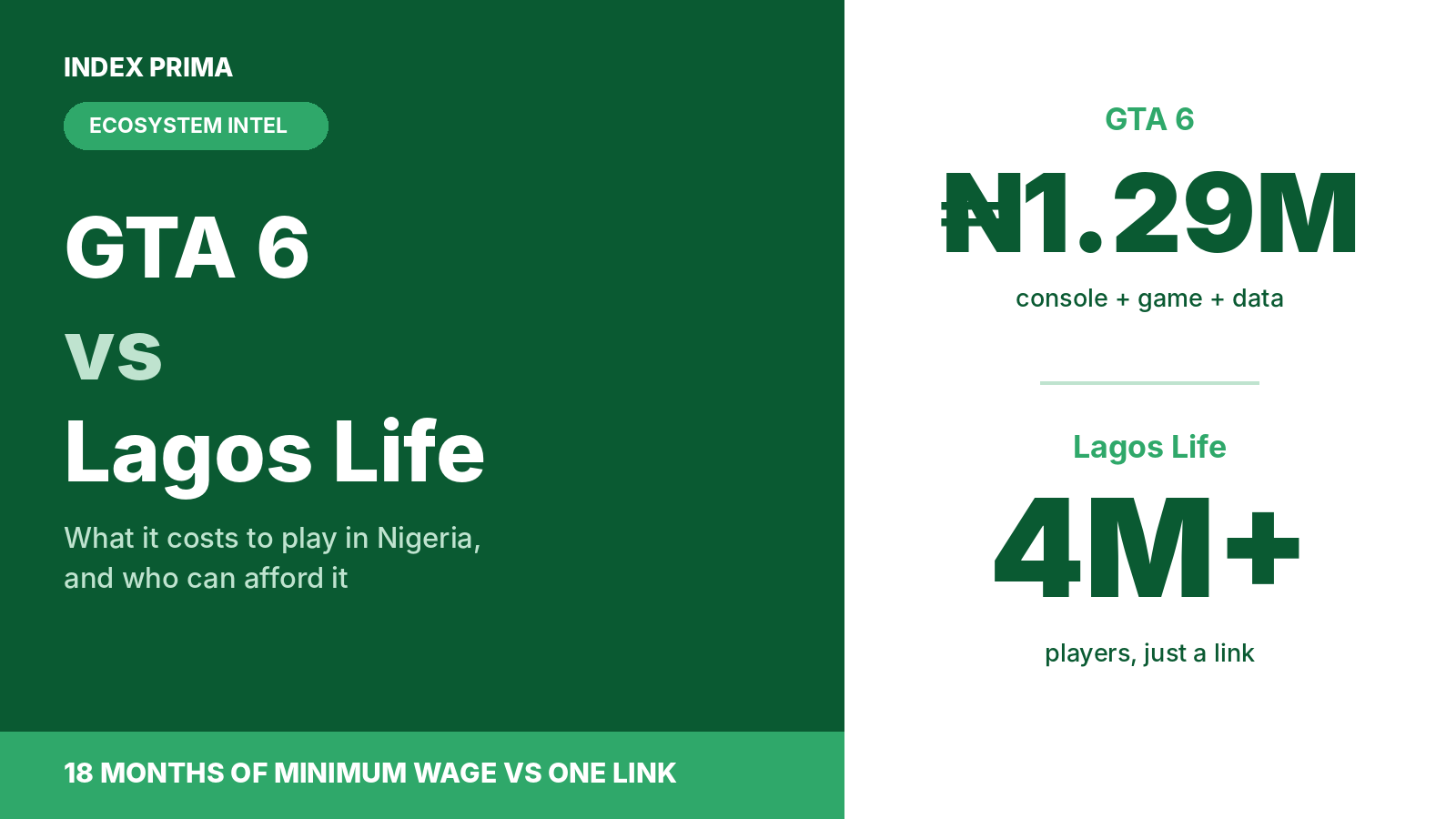
GTA 6 went on sale on 19 November, and a Nigerian who wants to play it needs about ₦1.29 million for a console, the game and the download data. That is more than 18 months of the national minimum wage, while a Lagos-themed browser game won millions of players in October with a single link.
The two launches sit at opposite ends of gaming. One is the biggest entertainment launch on record, priced for a console market most Nigerians are not part of. The other was built by a small Nigerian team in days, runs on any phone, and opens with a single link.
GTA 6 is a Rockstar game that runs only on PS5 and Xbox Series X|S, with no PC version confirmed. Sensor Tower estimates it earned about $1.84 billion by release day and sold more than 19 million copies. In Nigeria, the console alone costs about ₦1.14 million on Jumia, the Standard Edition adds about ₦108,000, and the 210 GB download needs a data bundle of around ₦40,000. Lagos Life, made by Shalom Rayhamen’s company Vatar, needs a link and a browser. It reached 1 million players in three days and has since passed 4 million, according to the company and press reports. Vatar then raised $500,000 at a $10 million valuation. The gap in cost is huge, but the comparison also has limits, and a million players is not a million regulars.
| Item | GTA 6 in Nigeria | Lagos Life |
|---|---|---|
| Device. | PS5 or Xbox Series X|S. About ₦1.14 million for a 1TB PS5 Slim on Jumia. | Any phone or computer with a browser. |
| Game price. | $79.99 Standard, $99.99 Ultimate. About ₦108,060 and ₦135,080 at ₦1,350.90 to the dollar. | A link on X or TikTok. |
| Download. | About 210 GB, with 212 GB of free space needed. | None. It runs in the browser. |
| Data to get started. | A 200 GB to 220 GB bundle costs ₦37,500 to ₦40,000. | Not stated. |
| Total to start. | About ₦1.25 million, or ₦1.29 million with an Airtel data bundle. | Nothing beyond a data connection. |
| Players. | More than 19 million copies sold worldwide by Thursday, per Sensor Tower. | About 4.3 million within a week, per Technext. |
| Money made. | About $1.84 billion by release day, per Sensor Tower. | More than $170,000 earned and contracted since launch, per The Condia. |
| Build. | A production cost of $1 billion to $1.5 billion, per AFP. | Built and launched in under a day with AI tools, per The Condia. |
The scale of the blockbuster is not in doubt. Before release, Forbes reported that Sensor Tower estimated about $1.54 billion in revenue and 16 million preorders. By release day, Sensor Tower put revenue near $1.84 billion, more than double the $815.7 million that GTA V earned in its first 24 hours in 2013. Its tracker showed 19.05 million units sold by Thursday, against 11.21 million for GTA V in its first day. About 75% of sales were on PlayStation and 25% on Xbox. These are third-party estimates, since Take-Two has not released official figures, and it is unclear how much came from launch-day buyers and how much from earlier preorders. The game also stands on a very large base. Take-Two says GTA V has sold about 230 million copies since 2013.
The price of entry in Nigeria is another matter. Take the US prices of $79.99 and $99.99 and convert at ₦1,350.90 to the dollar, the Thursday rate from Morningstar data cited by the source article. The Standard Edition then costs about ₦108,060 and the Ultimate Edition about ₦135,080. The console is the bigger cost. Jumia lists the 1TB PS5 Slim at ₦1,140,000, with shipping starting at ₦1,700 and electricity extra. Add the Standard Edition and the total is about ₦1.25 million. Add the cheapest bundle that covers the download and it is about ₦1.29 million.
By our sums, that is roughly $955. The national minimum wage is ₦70,000 a month, about $52 at the same rate, and the federal government has not announced a new one even as labour pushes for a review. The console and game together equal about 18 months of that wage. The console alone is more than 16 months, and the game alone is about a month and a half. One more comparison is ours, not the source’s. Sony raised US PS5 prices in April 2026 to $649.99 for the Disc Edition, according to The Gazette. If the Jumia listing is the disc model, the Nigerian shelf price of about $844 sits roughly 30% above that US price.
Data adds its own bill. The PS5 version needs about 210 GB to download and 212 GB of free space, and few monthly bundles are that large. MTN sells 200 GB for ₦37,500, Glo 210 GB for ₦40,000 and Airtel 220 GB for ₦40,000. Airtel is the only one that covers the download with room to spare, at about ₦182 a gigabyte against ₦188 for MTN and ₦190 for Glo. MTN’s bundle falls roughly 10 GB short. Glo’s leaves nothing spare. Buying the Airtel bundle lifts the total to about ₦1.29 million.
Buying the game is not always simple either. Within Nigeria found no official naira price and told readers to check their console store before budgeting. Rockstar says a purchase must match the region of your platform account, and Nigeria is not on its published list of PlayStation regions for boxed codes. Xbox codes are not region-locked, though a code from an overseas shop should be checked against your account’s country first. For a buyer who is already stretched, a wrong code is another cost.
The minimum wage is a floor, not an average, and some states already pay above it. Not every Nigerian player pays alone, either. Maliyo Games’ Nigeria Gaming and Esports Report describes a pipeline that runs from community gaming cafés, known as oniles, to national tournaments. Shared consoles lower the price per player. Even so, the wage figure shows how far the entry cost sits from the lowest legal pay, and the people who can afford the full bill are a small slice of the market.
Lagos Life took the opposite road. Shalom Rayhamen, who grew up playing The Sims, built a persistent browser simulation set in a virtual Lagos. Players find work, earn virtual naira, pay rent and ride public transport. The source article says it drew on The Sims 3 and on Eureka Studios’ Lagos Run. Players click a link on X or TikTok, make an avatar and start. There is no download and no app-store listing. In Rayhamen’s words, “I grew up playing The Sims and always wondered what it would look like if the characters lived in my city.” Later, he said, “Four million people have now shown us the answer.”
The growth was fast. Lagos Life crossed 1 million players in three days, faster than the five days ChatGPT needed, the source article notes. Within a week, Technext reported 4.3 million players from 15 countries and more than 200,000 online at peak. Other reports give slightly different counts for different days. Technext’s earlier tally had nearly 2.5 million players and 23 million visits by day four, with peak concurrent users above 122,000. A WeAreTech brief reported 4.7 million users. These are figures from the company and the press, so treat them as estimates.
Money has followed, though the numbers are modest next to the players. In its first four days, Technext reports, the game earned roughly $46,900, or ₦62 million, from billboard sales to Nigerian brands and startups, plus in-game player transactions. The Condia says Vatar has generated more than $170,000 in earned and contracted revenue since launch. By our sums, that is about four US cents a player if all 4.3 million are counted, though the revenue includes contracted deals and the players are not all regulars. Vatar then closed a $500,000 angel round that took a day at a $10 million valuation. Backers include Flutterwave chief executive Olugbenga Agboola through his fund Resilience17, Oo Nwoye, Mono chief executive Abdulhamid Hassan and Terra Industries chief executive Nathan Nwachuku. Nwachuku wrote on X that “simulation gaming is entering a new era” of localised experiences.
Lagos Life is not the only proof. Lagos Run, an endless runner built by Berlin-based Nigerian engineer Opeyemi Adeniran under Eureka Studios, reached more than 140,000 players in 145 countries within seven days, with over 10 million impressions on X, Technext reports. Adeniran built it in four to five weeks as an after-work project, using AI tools for code and visuals. Two small teams with AI tools and a link reached a global audience that earlier Nigerian studios spent years chasing.
History explains why this is new. Technext lists five earlier Lagos-themed games and how they fared. The Danfo series, first made in 2007 and later grown by ChopUp, passed a million downloads across its catalogue and drew $100,000 in venture money in 2014, but stalled in the move from Java phones to app stores. Maliyo Games’ Okada Ride was a web game in 2012, a good fit for Nigeria’s 44 million web users then, but the shift to mobile pushed the studio toward business partnerships. Gamsole’s Gidi Run in 2016 billed players through MTN airtime, which avoided credit cards but tied revenue to the operator’s cut. Maliyo’s Aboki Run earned little because acquiring users cost a lot and ad rates on African traffic were low. And Idansquest, from the three-person Hfrogames in August 2025, struggled because data-conscious players were unwilling to spend data on an app install. The common blocks were data costs, app-store friction and weak ways to turn players into payers.
The 2026 games worked around each block. AI shortened development from years to weeks, and the browser removed the install step. Players could start within seconds of opening a link, which let Lagos Life sell advertising straight to local brands without app stores or card payments. That is the real contrast with GTA 6. One model asks the player to pay first and sells hardware, software and data. The other lets the player in first and earns later from brands and in-game spending.
The wider market backs this reading. Maliyo’s report, summarised by Games Industry Africa, counts 46.6 million active players in Nigeria and projects annual gaming revenue reaching $300 million, with 90% of players on smartphones. The summary gives no console share. For Africa as a whole, the State of the African Video Game Industry 2026 report puts 2024 revenue at about $1.8 billion, with mobile making up nearly 90% of that. It names payment friction, limited funding, uneven infrastructure and the lack of a single continental market as constraints. If nine in ten Nigerian players are on phones, a game that needs a ₦1.14 million console reaches a thin slice of them, though how thin that slice is has not been measured.
The comparison also has limits. GTA 6 is a game with a budget of $1 billion or more, built for a global market that pays dollars. Lagos Life is a simple simulation made for one city. They do not offer the same experience, and a browser game cannot replace a blockbuster. Technext notes that the game’s revenue and server costs at this scale remain unclear. A million players are not a million regulars, and the long test is whether people keep coming back and whether brands keep paying. A small studio also cannot match a decade-long library like GTA V’s.
Our reading is that the contrast is less about two games than about two ways to reach Nigerians. GTA 6 is priced for a console market that most Nigerians do not belong to. Lagos Life needed only a link. The best chance for Nigerian developers lies in games built for the phone, the browser and the data bundle that players already have, with revenue that does not depend on the player’s wallet at the door.
Why it matters: Global launches are often treated as shared moments, but entry costs decide who joins in. A cost of 18 months of minimum wage turns a headline launch into a spectator event for most Nigerians. Meanwhile, browser games built with AI tools show that local studios can reach millions without app stores, card payments or big budgets. If brands keep paying and players keep returning, that could support a home-grown games sector. If not, Lagos Life may remain a viral moment with modest earnings.
What to watch next: whether Lagos Life keeps its players past the first weeks, and what share log in each day. Watch Vatar’s revenue and server costs as it scales, and how it uses its $500,000. Watch whether other Nigerian and African studios copy the browser-first, AI-built model. Watch whether Sony, Microsoft and Rockstar publish naira prices or local payment options. Watch whether the federal government announces a new minimum wage. And watch whether data bundles get cheaper, since that cost shapes every game that is played online.
Sources: Epiphanus Obia, “GTA 6 vs Lagos Life: What it costs to play in Nigeria, and who can afford it”, November 2026; Fox 5 DC, “GTA VI pulls in estimated $1.84 billion by release day”, November 2026; Within Nigeria, “How much is GTA 6? Price, editions, pre-order bonuses and where to buy”, 18 November 2026; The Condia, “Company behind viral Nigerian game Lagos Life raises $500k”, 9 October 2026; Technext, “As Lagos Run and Lagos Life shatter records, here are 5 earlier Lagos-themed games and how they fared”, October 2026; Games Industry Africa on Maliyo Games’ Nigeria Gaming and Esports Report, 5 November 2025; Xsolla on the State of the African Video Game Industry 2026; The Gazette, “Sony increases PS5 prices globally”, 2026; WeAreTech Africa on Vatar’s raise.
A note for startup founders: Don’t practice on investors. Practice on AI first. RaiseReady by Index Prima is an AI fundraising simulator for African founders: upload your pitch deck, get a readiness score and face a tough AI investor before the real meeting. Find this post, and every post we publish, at raiseready.indexprima.com.