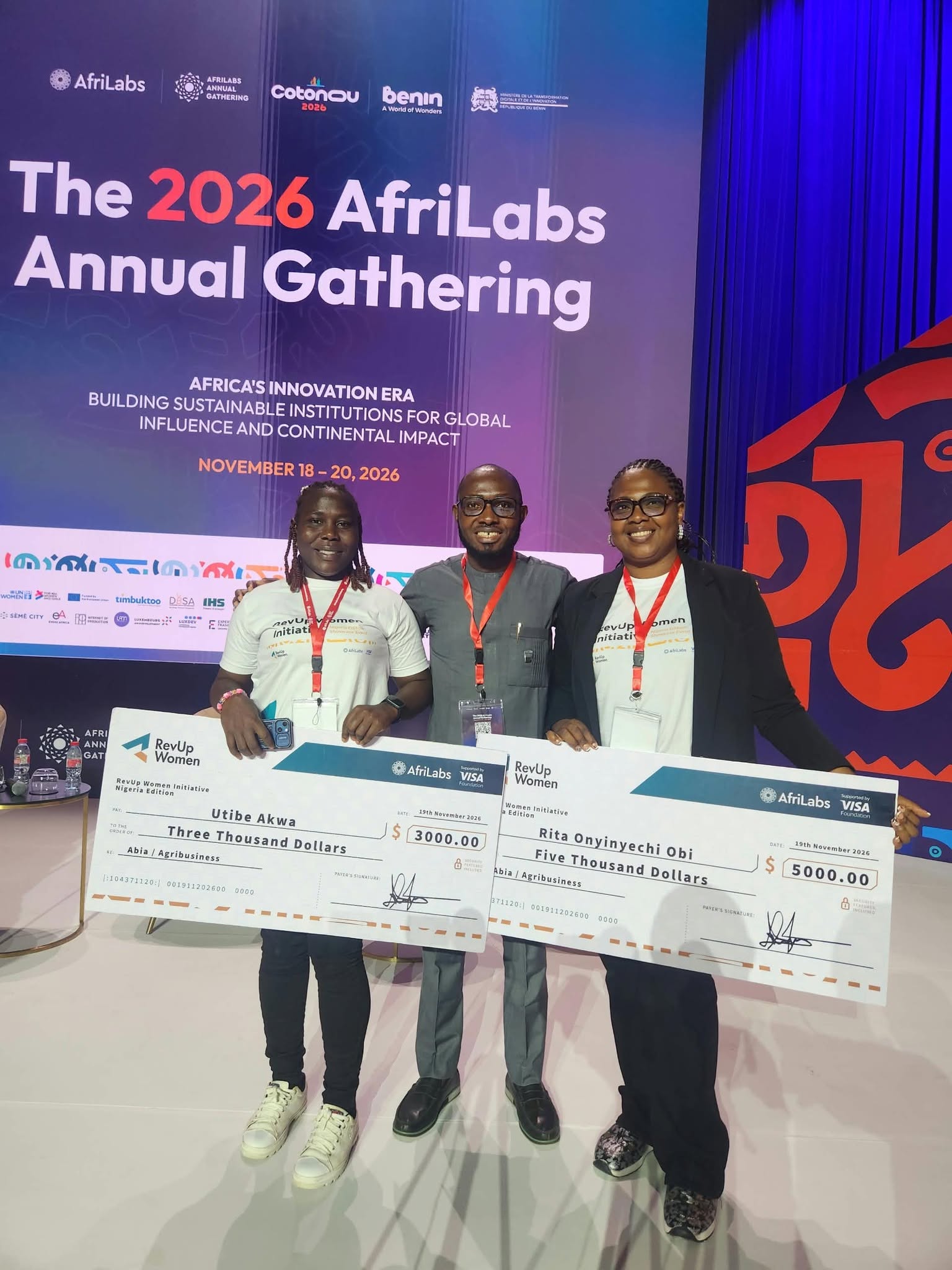
Two women-led food businesses in Aba, Abia State, took home $8,000 between them at the RevUp Women Demo Day, funded by the Visa Foundation and run by AfriLabs with RAD5 Tech Hub. Business coach Igwe Uguru says he mentored two Aba founders to a combined $8,000 and celebrated with them on stage in Cotonou, Benin.
The money is non-equity, so founders keep all their shares. Rita Obi of Fendol Limited, a fish processor, won $5,000, and Utibe Akwa of Utytrends Global Ventures, a food producer, won $3,000. Ten finalists pitched, and the cash is released only after final vetting and compliance checks by AfriLabs and the Visa Foundation. Uguru calls it “free equity funding” in his post. Reports on the Demo Day describe it as non-equity funding, and the difference matters for any founder who reads the news and plans a pitch.
| Item | Detail |
|---|---|
| Programme. | RevUp Women Initiative, funded by the Visa Foundation, run by AfriLabs, with RAD5 Tech Hub as partner. |
| Demo Day. | Aba, Abia State, on a weekend before 29 April 2026. |
| Finalists. | 10, each with 5 minutes to pitch and 5 for questions. |
| First prize. | $5,000, Rita Obi, Fendol Limited (dry and wet fish). |
| Second prize. | $3,000, Utibe Akwa, Utytrends Global Ventures (food production). |
| Type of funding. | Non-equity. Paid after vetting and compliance checks. |
| Other finalists. | Consolation packages from Oraimo. |
| Not stated. | How many founders applied in Abia, and when the money is paid. |
RevUp Women is AfriLabs’ programme for female entrepreneurs. The Nigerian edition was announced in February 2026 as a 12-week course for 150 women in Abuja, Lagos and Abia. It mixes training, mentorship and workshops, and it ends in a Demo Day. Before the Aba event, finalists took sessions on business development, pitch readiness and scaling. RAD5 Tech Hub, a hardware and innovation hub on Factory Road in Aba, led that training with other partners. Judges Paschal Etien, Irunna Ejibe and Nnamdi Ajah looked at financial projections, scalability, product-market fit, traction and how clear each business model was.
The two winners show what judges rewarded. Obi says Fendol keeps several thousand fish in its reservoirs and serves customers across Nigeria. Akwa says Utytrends sold 16,000 units in 2024, is exploring a distribution deal with the makers of Golden Morn, and could make up to 50,000 units if it buys an automatic sealing machine. She projects annual revenue of up to ₦60 million if the plan works. These are the founders’ own claims. Both are physical goods firms with a clear next step and a clear use for the cash.
Uguru’s post adds the human side. He says he coached two women-led business owners in Aba, then stood on stage with them in Cotonou. The AfriLabs Annual Gathering, its 11th and its first in a French-speaking country, ran in Cotonou from 18 to 20 November at the Sofitel Cotonou Marina Hotel and Spa. AfriLabs said more than 1,200 people would attend. The event’s published programme lists tracks on investment, policy, hubs and trade. It does not list RevUp Women. His post does not name the two founders. The $8,000 total matches the Aba prizes, so our reading is that he means the Demo Day winners, but that is our inference and not a stated fact.
By our sums, the two prizes split $8,000 as 62.5% and 37.5%. Two of ten finalists took all the cash, and eight left with consolation packages. That is a steep drop, and it shows why prep matters. The same programme in 2024 gave 10 women $10,000 each, $100,000 in all, across Nigeria, Kenya, South Africa, Cameroon and the DRC, according to BusinessDay. This round paid less per winner but reached a hub city in the South East.
The lesson for founders is practical. A five-minute pitch needs numbers, a use for the money and proof of sales. Akwa’s units sold and her sealing machine, and Obi’s customer reach, gave judges something concrete. A coach or hub can help with that, but no source says how much help each winner received.
Founders should also read the fine print on “free” money. Non-equity funding can come with vetting, reporting and compliance steps before payment. Ask what documents are needed, when funds arrive and how they may be spent.
Why it matters: Women-led firms in secondary cities such as Aba often miss out on funding that stays in Lagos and Abuja. A programme that trains women, holds a Demo Day on home ground and pays cash without taking shares can change what a small food firm can buy. The coach-and-hub model also shows that regional stages and local mentors can lift founders who might never reach a big investor room.
What to watch next: when the $8,000 is paid, and what Fendol and Utytrends buy with it. Watch whether the Abuja and Lagos cohorts name their winners. Watch for the next RevUp round and whether Abia hosts again. Watch whether RAD5 and other South East hubs build more coaching pipelines. And watch whether such winners go on to raise equity.
Sources: Igwe Uguru, Facebook post on the RevUp Women winners and the Cotonou stage, November 2026; Nigeria Startup Act, “RevUp Women Initiative awards $8,000 to two women entrepreneurs”, 29 April 2026; We Are Tech Africa, “RevUp Women launches 12-week business development program for Nigerian female entrepreneurs”, 10 February 2026; BusinessDay, “Revup Women Initiative: 10 entrepreneurs awarded $100,000 in grants”, 28 April 2024; AfriLabs Events, “AfriLabs Annual Gathering 2026”, November 2026; La Nouvelle Tribune, “A Cotonou, AfriLabs interpelle les investisseurs sur le financement de l’innovation”, November 2026; VC4A, “RAD5 Tech Hub”.
A note for startup founders: Don’t practice on investors. Practice on AI first. RaiseReady by Index Prima is an AI fundraising simulator for African founders: upload your pitch deck, get a readiness score and face a tough AI investor before the real meeting. Find this post, and every post we publish, at raiseready.indexprima.com.