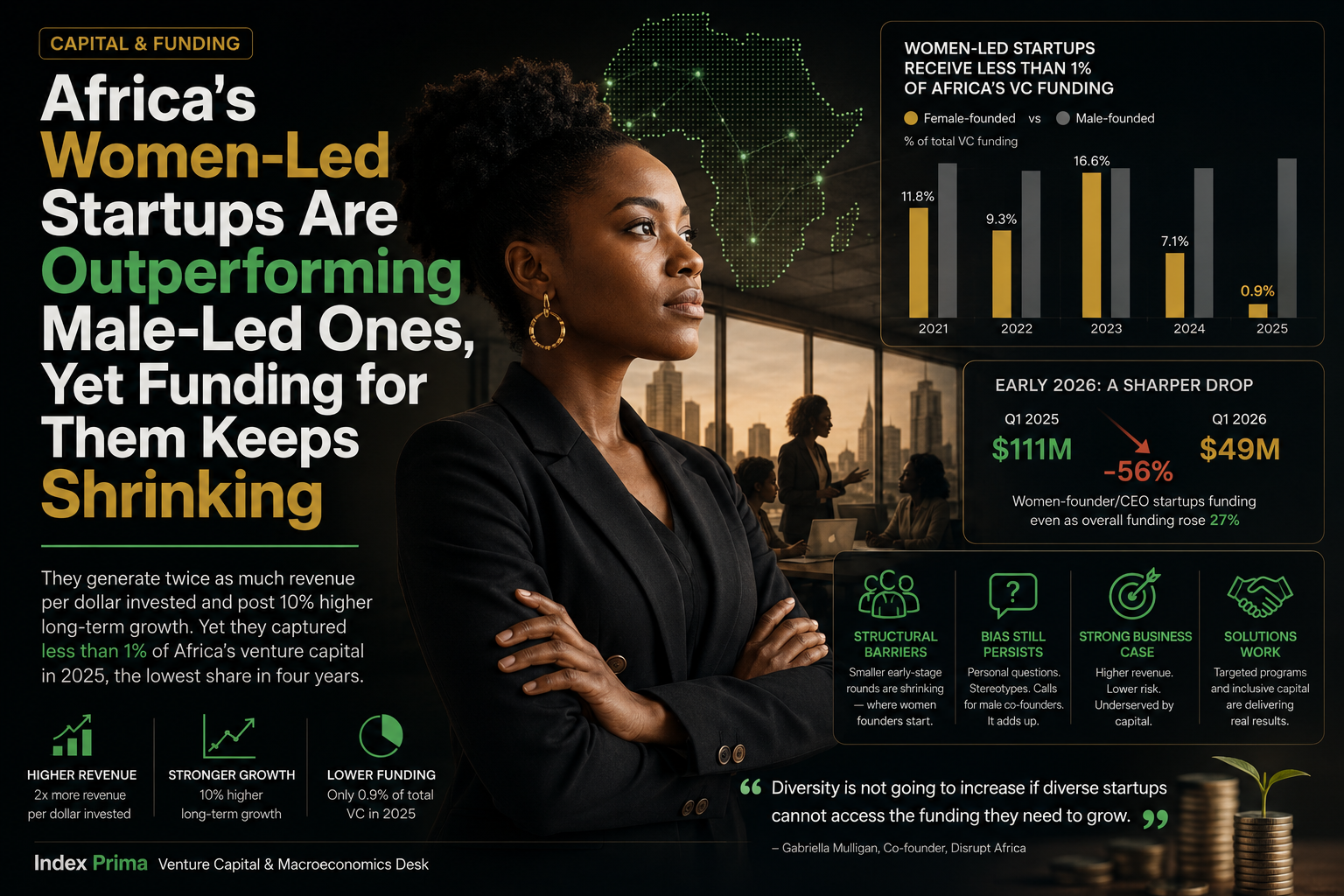
Women-led startups in Africa generate twice as much revenue per dollar invested and post 10% higher long-term growth than their male-led peers. Despite that, they captured less than 1% of the continent’s venture capital in 2025, the lowest share in four years. That gap between performance and funding is not new, but new data shows it is getting wider, not narrower, even as overall startup funding across Africa recovers.
What the Data Actually Shows
The clearest picture comes from Disrupt Africa’s Diversity Dividend report, produced with Madica, Thinkroom, and Jumpstarter Crowdfunding, which tracked more than 3,000 African startups alongside interviews with founders and investors. In 2025, only 30 of the 178 funded startups tracked, just 16.9%, included a woman on the founding team. Only 17, or 9.6%, had a female CEO. Female-founded startups took home just 0.9% of the $3.2 billion raised by African tech companies that year.
The share of funding going to women has swung sharply over the past five years rather than moving steadily in one direction. Ventures with a female co-founder captured 11.8% of total capital in 2021, fell to 9.3% in 2022, rebounded to 16.6% in 2023, then dropped again to 7.1% in 2024. Funding for female CEO-led startups followed a similar rollercoaster path. That volatility matters because it shows the gap isn’t closing steadily, it’s swinging, and 2026 so far points toward another downswing.
A Sharper Drop in 2026
Early data for this year is the most concerning part of the story. Startups with at least one woman founder or CEO raised just $49 million in the first quarter of 2026, down 56% from the $111 million raised in the same period a year earlier. That decline happened even as overall African startup funding rose 27% over the same stretch. More money is flowing into African tech again. Very little of the increase is reaching women.
Why the Gap Keeps Widening
Part of the explanation is structural, not just behavioral. Investors have been concentrating capital into fewer, larger, later-stage deals, while the earliest funding rounds, pre-seed and seed checks under $500,000 especially, have contracted sharply. Those smaller, earlier rounds are exactly the ones women founders disproportionately depend on to get a company off the ground in the first place. When that segment of the market shrinks, women-led startups lose access disproportionately, even before bias enters the picture at all.
Bias still shows up directly in fundraising conversations, though. The Diversity Dividend research documented investors asking female founders about personal life questions rarely posed to men, and some investors suggesting a women-led team needs a male co-founder before it can be taken seriously. Gabriella Mulligan, co-founder of Disrupt Africa, put the core problem plainly: diversity is not going to increase if diverse startups cannot access the funding they need to grow.
The Business Case Investors Are Leaving on the Table
The performance numbers make the funding gap harder to justify on purely financial grounds. Beyond the revenue and growth figures, a Boston Consulting Group and World Economic Forum analysis put the accumulated funding gap between women-founded and male-founded African startups at $2.5 billion over the past five years. Zoom out from tech specifically to the broader small business economy, and the African Development Bank estimates women entrepreneurs across the continent face a $42 billion financing gap overall, despite owning the majority of small businesses in many African markets.
Where the Gap Is Actually Closing
The picture isn’t uniformly bleak. Some programs are producing real, measurable results by designing specifically for women founders rather than hoping broader initiatives reach them by default. Seven of the twelve startups in the Mastercard Foundation EdTech Fellowship’s most recent cohort were women-led, a deliberate outcome rather than a coincidence. The African Development Bank’s AFAWA initiative works directly with financial institutions across the continent to build lending products and equity facilities designed around women-led businesses specifically.
The risk data backs up the case for doing more of this. In Ghana and Kenya, micro-lending fintechs that specifically target women borrowers report default rates below 2%, compared with an industry average of 5% to 7%. Women-led agribusiness cooperatives in Rwanda and Côte d’Ivoire have shown particularly strong export resilience through recent periods of global market volatility. None of this suggests women entrepreneurs are a higher-risk bet. If anything, the evidence points the other way.
What It Adds Up To
Representation among African startup founders has genuinely improved over the past two years. Access to the capital that turns a founding team into a scaled business has not kept pace, and in 2026 it’s moving in the wrong direction entirely. Closing that gap will take more than encouraging more women to start companies, since that part of the pipeline is already working. It will take investors treating the performance data seriously enough to change where the checks actually go.