A new study says AI and blockchain could cut waste and open markets for African fruit and vegetable growers. But it warns that farmers will gain little unless four problems are fixed first, and the biggest one is who owns the farm data.
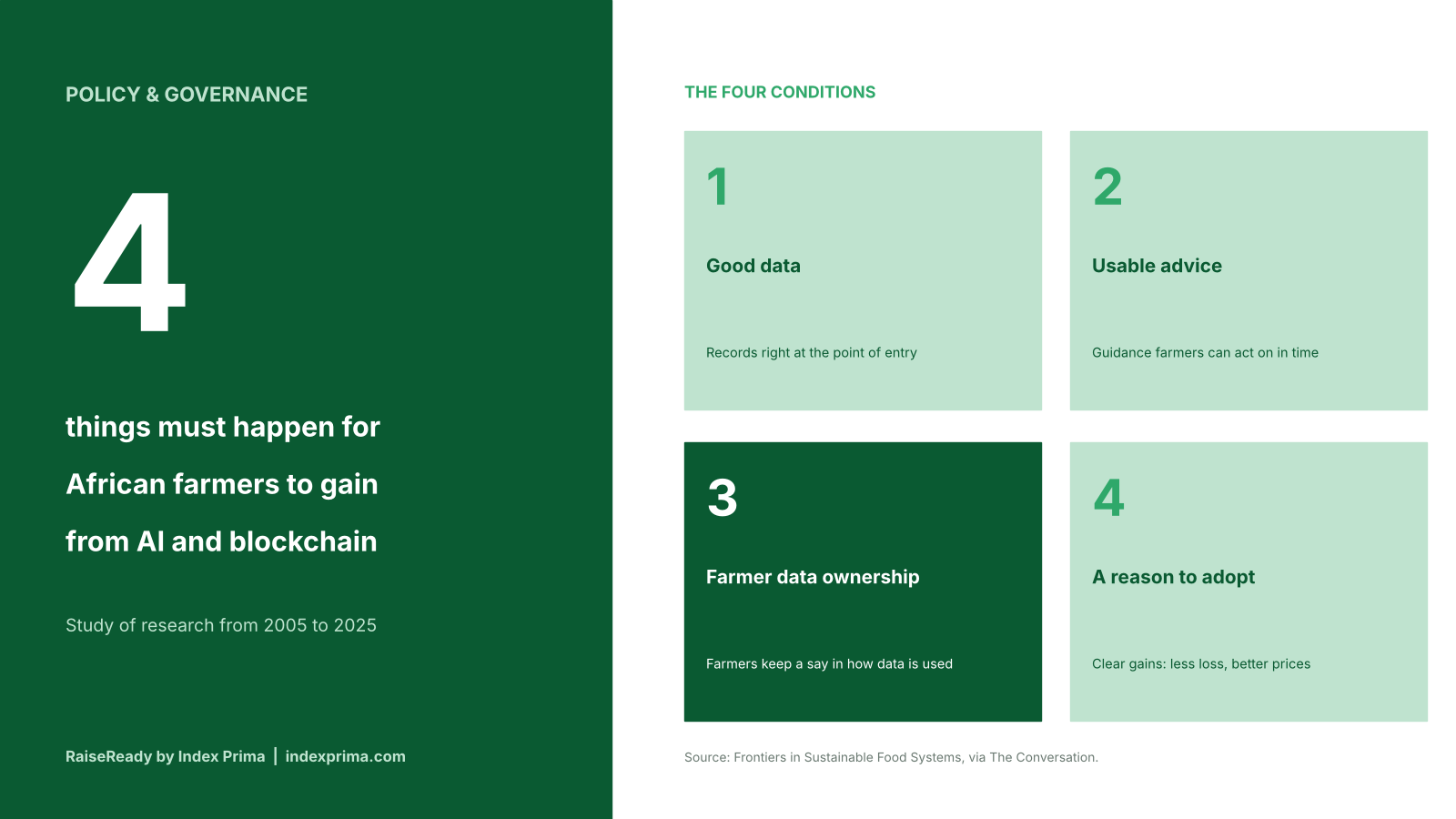
Researchers in horticulture, post-harvest technology and agricultural engineering reviewed studies from 2005 to 2025 on AI and blockchain in farming. Their paper appears in Frontiers in Sustainable Food Systems. They found that many projects focus on what the technology can do. Far fewer focus on the farmer who must use it, the conditions on the farm, or the rules on data. The four conditions they set out are good data, advice farmers can act on, farmer control of data, and a clear economic reason to adopt. The warning comes as investors are backing African agritech less than before: funding fell about 19% in 2025.
Start with the idea. AI can study images and farm data to spot crop problems, predict pest outbreaks or flag crop stress. Blockchain is a shared digital record that is hard to change after the fact. It can log where produce came from and how it moved along the supply chain. Joined together, the two could help verify quality and handling for perishable crops, and reduce post-harvest losses. That matters in horticulture, where fruit and vegetables spoil fast.
The study’s first warning is a simple one. Blockchain protects a record after it is entered, but it cannot confirm the record was right in the first place. As the authors’ article puts it, it “cannot guarantee that the original information was correct.” If a sensor is faulty or a worker enters the wrong figure, the AI built on that data will give poor advice. The record will look neat and trustworthy, and it will still be wrong.
The four conditions are worth setting out in full.
| Condition | What the study says |
|---|---|
| Good data. | Records must be right at the point of entry. Poor inputs lead to poor AI advice. |
| Decisions, not just information. | Farmers need guidance in time to act. A correct warning that arrives late is of little use. |
| Data ownership. | Farmers produce valuable data but have little say in how it is used. |
| A reason to adopt. | The tool must bring clear gains, such as less loss, lower costs, higher yields, better prices or new markets. |
On the second point, the study stresses local conditions. Many smallholders have limited smartphone access, patchy internet, costly mobile data and few digital skills. So tools should work offline where they can, and use local languages, text messages or voice. Farmers should help design them. The article gives examples of how this can work. AI-powered apps that spot crop disease offline are being built in Cameroon. Hello Tractor uses machine learning to track tractor use and send weather forecasts by text message in areas with weak internet. These are specific cases, though. Wider use of sensors and precision farming is held back by high start-up costs and by small, scattered plots of land.
Now the data question, which is where the debate is sharpest. Farm data covers soils, crop performance, pests, fertiliser use, water, yields and market sales. Put together, it can train AI models, shape products, assess risk and support lending and insurance. That is valuable. But without clear rules, farmers could become unpaid suppliers of data to larger agribusinesses, exporters or technology firms, while the biggest gains go elsewhere. The study says digital farming could then repeat old inequalities.
Its answer is to set rules early. They should say who can see farm data, who checks AI decisions, who is responsible when something goes wrong, and how farmers are protected. The authors also suggest community-governed data arrangements. Farmers would have a real role in how data is collected, shared and reused. Farmer groups could negotiate on their behalf, since one farmer alone has little power. And before any scheme grows, governments, technology firms and agribusinesses should check four things. Is the information reliable? Can farmers act on it? Who controls the data? Does it deliver measurable benefits?
The money picture adds weight to the study’s last point. African agritech funding fell to $168.1 million in 2025, down from $206.9 million in 2024, according to Briter Intelligence data reported by TechCabal. That is a fall of about 18.8% by our sums. Deals fell from 146 to 135. Lola Masha, a partner at the venture firm Antler, said “capital always follows the path of least resistance.” Crop2Cash co-founder Seyi Alabi said he felt he was “starting from a goal or two down” when he pitched for seed funding. With less money about, projects that cannot show a clear gain for farmers will struggle to raise more.
A note on figures. The Moneyweb report that prompted this story repeats older market numbers. They include an agritech market of about $5 billion in 2021, expected growth of more than 12% a year by 2025, and $1.2 billion raised in 2023. We did not use them, because they are dated and they do not match the 2025 figures from Briter, which show a much smaller pool.
Why it matters: Africa’s farms are about to be sold a lot of digital tools. Some will help. Many will be built for exporters, lenders or investors, with the farmer as a source of data and not as a customer. This study gives growers, cooperatives, founders and regulators a plain test. Is the data right? Can the farmer act on it in time? Does the farmer control it? And does it pay? For farmers and cooperatives, the practical step is to ask who gets the data and what you get back before you sign up to any platform. For founders, the lesson is to design for weak signal, local languages and small plots, and to show a gain in the farmer’s pocket. For ministries of agriculture, it is to write data rights into the rules before the systems scale.
What to watch next: whether any African country or regional body sets formal rules on agricultural data rights. Watch for farmer groups or cooperatives that start to manage their data together. Watch whether traceability projects publish results on loss reduction and farmer income, not just on tracking. Watch the next Briter figures to see whether agritech funding recovers in 2026. And watch whether tools built for exporters start to serve smallholders on their own terms.
Sources: Bizcommunity (republished from The Conversation) on four things that must happen for African farmers to benefit from AI and blockchain; Frontiers in Sustainable Food Systems study; [Moneyweb report on AI and blockchain in African horticulture, 7 November 2026]; TechCabal on agritech funding in Africa in 2025.
A note for startup founders: Don’t practice on investors. Practice on AI first. RaiseReady by Index Prima is an AI fundraising simulator for African founders: upload your pitch deck, get a readiness score and face a tough AI investor before the real meeting. Find this post, and every post we publish, at raiseready.indexprima.com.