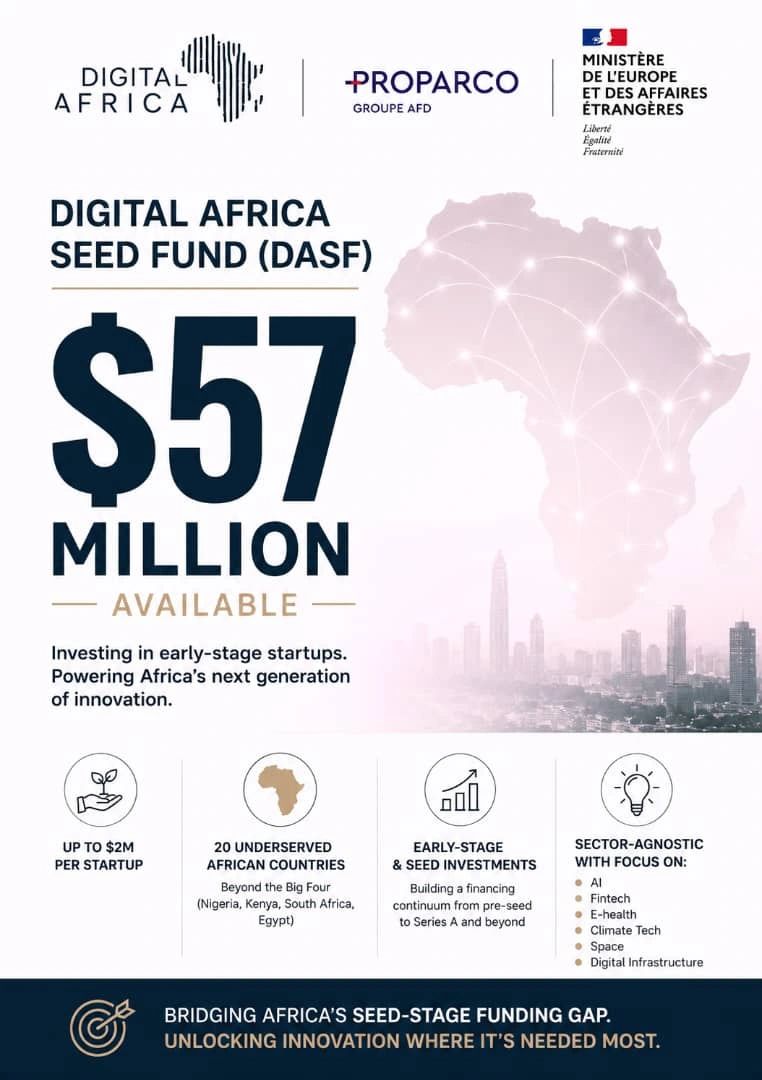
Digital Africa, the French government backed pan-African startup initiative, has officially launched the Digital Africa Seed Fund, a dedicated seed stage vehicle targeting between €30 million and €50 million, roughly $34 million to $57 million. The fund was unveiled at the Africa Forward Summit in Nairobi on May 12, 2026, and it exists to solve a specific, well documented problem: the vast majority of venture capital flowing into African startups still concentrates in four markets, Nigeria, Kenya, South Africa, and Egypt, leaving founders everywhere else competing for a much smaller pool of institutional capital. DASF is built explicitly to write checks outside that big four, targeting roughly 30 startups across approximately 20 priority countries, with individual ticket sizes ranging from €300,000 up to €2 million.
The fund sits inside a coalition of development finance backers rather than a single sponsor. Proparco, the private sector investment arm of Agence Française de Développement, anchors the structure, alongside AFD itself, the French Ministry for Europe and Foreign Affairs, the European Union, and the West African Development Bank, known by its French acronym BOAD. That’s a notably broader backing group than a typical single country initiative, and it reflects how DASF has been positioned from the outset, less as a one off French government gesture and more as coordinated European development finance aimed specifically at Africa’s seed stage financing gap.
Digital Africa itself isn’t new to this work. Founded in 2018 and headquartered in France, it operates as a pan-African programme rather than a startup with its own founders, and it already runs Fuzé, a pre-seed instrument that has backed more than 70 startups across 16 African countries since launch. DASF is designed as the next rung on that same ladder, extending Digital Africa’s involvement with a startup from its earliest, riskiest stage through seed funding, at which point Proparco’s own Series A and later stage activity is meant to pick up the relationship. The organization describes this as building a full financing continuum, rather than funding a company once and leaving it to find its own way to the next round. According to Digital Africa’s own framing of the problem, the gap founders face in these markets isn’t only about money. It’s about the structured support that helps a company move from early traction to Pre Series A readiness, a transition the organization describes as carrying a fundamentally different risk profile than a startup faces at its very first check, and one that DASF was built specifically to bridge.
The sector focus tracks closely with where global capital has been moving generally: artificial intelligence, fintech, e-health, climate tech, space technology, and digital infrastructure. Geographically, the fund’s stated preference for Francophone West Africa, East African markets outside Kenya, and other historically underfunded ecosystems reflects just how skewed African venture capital distribution has become. Even within the continent’s four dominant hubs, concentration runs deep. Nigerian startups alone reportedly raised around $343 million over a recent stretch, still trailing Kenya, South Africa, and Egypt in total capital raised, which gives some sense of just how much smaller the pool gets once you move outside all four markets entirely, into the twenty DASF is targeting.
The launch’s timing gave it more visibility than a standalone fund announcement usually gets. It landed during the closing session of the Africa Forward Summit, the same session where French President Emmanuel Macron announced what his office described as €23 billion in investment commitments for Africa. DASF is a small piece of that much larger figure, but analysts covering the announcement have noted its mechanics are considerably more specific, and its investment thesis more grounded, than the kind of broad, summit stage commitments that don’t always translate into deployed capital. A closed end fund with a defined ten year investment horizon, explicit ticket size ranges, and a stated startup count is a different kind of commitment than a headline number attached to a presidential visit.
Whether that specificity translates into real outcomes for founders is still an open question, and a fair one. For a founder in one of DASF’s twenty target markets, the immediately relevant facts are that €1 million to €2 million rounds remain genuinely transformative at seed stage in these ecosystems, and that a fund of this size represents one of the more systematically structured sources of that kind of capital currently available outside Africa’s big four. Fuzé’s track record, more than 70 companies backed across 16 countries, offers some early evidence that Digital Africa can execute at this kind of scale, though deploying larger checks across twenty markets simultaneously is a meaningfully harder operational challenge than the pre-seed work that preceded it. The next three years of deployment, not this month’s headline, will be what actually answers whether DASF closes the gap it was built for or simply narrows it.
Interested founders can review eligibility and apply directly through Digital Africa’s website, with additional detail on the fund itself available through the Digital Africa Seed Fund page and background on Proparco’s broader mandate on its own site.