For years, the Middle East and North African tech ecosystem has been heavily skewed toward software—SaaS plugins, fintech wallets, and AI chatbots. While capital-efficient, software does not solve the structural vulnerabilities of the real economy, such as agricultural labor shortages and post-harvest food waste.
Founded by a team with over 50 years of collective robotics experience, Egrobots has broken this mold. By building a high-fidelity, hardware-integrated AI system entirely designed and manufactured by Egyptian engineers, they are bringing cognitive computing to the physical dirt.
-
The Agribusiness Pain Point: Tight harvesting windows mean that a brief delay in manual labor results in massive, irreversible crop spoilage.
-
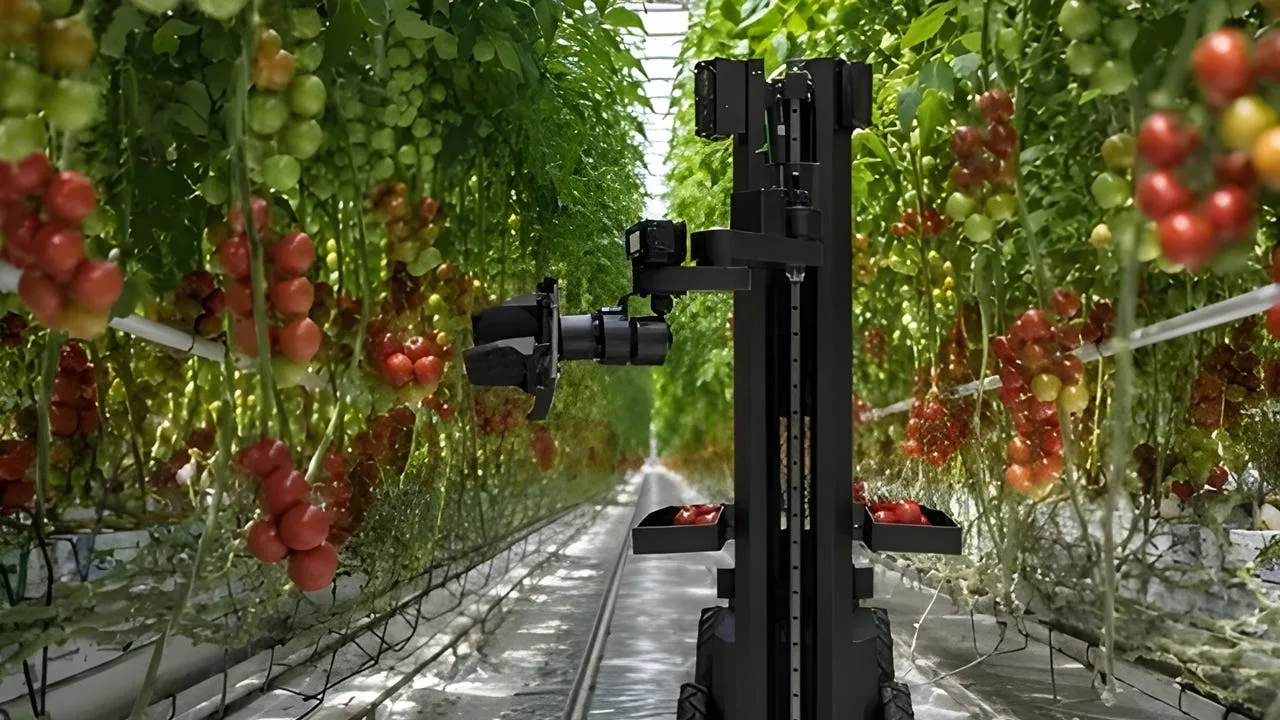
The Physical AI Solution: A tireless, machine-vision-driven machine that optimizes harvest timing, completely deleting seasonal labor dependencies and significantly dropping operational overhead.
The machine is a complex synthesis of spatial computing and soft robotics, running on a multi-layered technical stack:
-
The Computer Vision Layer: Advanced machine learning models continuously process color, spectrum, and texture data to evaluate ripeness. It can identify and target perfectly mature produce (e.g., tomatoes) while leaving unripened crops intact.
-
Proprietary SLAM Navigation: Operating entirely without human oversight or a continuous GPS connection, the robot uses a Simultaneous Localization and Mapping (SLAM) architecture to map fields and avoid dynamic obstacles in real time.
-
Simultaneous Quad-Arms: The physical chassis supports up to four robotic limbs operating in parallel. These arms use specialized, pressure-sensitive soft grippers to harvest delicate produce without causing bruising or structural cell damage to the fruit.
Egrobots is executing its rollout by leveraging global infrastructure networks and a proven track record in state-level deployment:
-
The Global Infrastructure Rail: As a graduate of the Google for Startups cohort and an active member of the NVIDIA Inception network, the startup has hard-coded its deeptech development on top-tier GPU and cloud compute resources.
-
The Stress-Testing Lineage: This is not a fragile lab experiment. Egrobots previously developed and deployed a specialized traffic management robot in partnership with the Egyptian Ministry of Interior, proving their capability to transition autonomous systems from conceptual code into chaotic, real-world environments.
Egrobots Autonomous Harvester Ledger
| Technical Metric | Specification / Lineage | Economic & Operational Utility |
| Origin Point | Egypt (Fully Localized Engineering) | Reduces dependency on imported automation |
| Harvesting Output | ~160 Kilograms of crops per hour | High-density industrial scale yield processing |
| Operational Window | 24 / 7 Continuous Execution | Maximizes efficiency during peak seasonal windows |
| Navigation System | Offline Proprietary SLAM | Zero reliance on external GPS or network uptime |
| Manipulator Array | 4 Simultaneous Soft-Touch Robotic Arms | High-fidelity picking without bruising produce |
| Ecosystem Alliances | NVIDIA Inception & Google for Startups | Direct access to global deeptech compute pipelines |
For deeptech founders building hardware for legacy, traditional industries, the Egrobots model highlights critical Strategic Checkpoints:
-
Hardware is Nothing Without Maintenance: The ultimate survival metric for agricultural hardware is localized support. A software bug can be patched via an over-the-air API update; a broken mechanical joint requires a physical technician. Founders must establish distributed maintenance hubs alongside their sales pipeline.
-
Price out the Labor Arbitrage: To win over traditional farmers, the total cost of robot ownership (amortization + power + maintenance) must be mathematically cheaper and more reliable than manual seasonal labor.
-
Frictionless UI/UX: The interface for managing a fleet of autonomous harvesters cannot require an engineering degree. The operator interface must be as simple as a basic smartphone app, adapting to the literacy levels of local farm managers.
Sources & References
-
[1] Disrupt Africa: Egypt’s Egrobots unveils AI-powered harvesting robot
-
[2] Wamda: Egrobots unveils AI-powered harvesting robot built entirely by Egyptian engineers
-
[3] Middle East AI News: Egrobots launches Arab world’s first autonomous agricultural harvester
The “Index” Take: In 2021, African and Middle Eastern AI was almost entirely bound to screens and spreadsheets. In 2026, Egrobots is proving that Cognition is Moving into the Material World. By hard-coding machine vision onto a localized, quad-arm mechanical rail, they aren’t just automating farms—they are building a sovereign food security layer for a region highly vulnerable to supply chain shocks. If they can successfully scale their production and onboarding rails, this Egyptian-built machine will mark a historic transition from software consumption to deeptech production.