Imagine getting funding without giving away a single share. The Founders Support Initiative (FSI) offers that to early-stage African founders. Its first call has closed, but the next one is worth preparing for now.
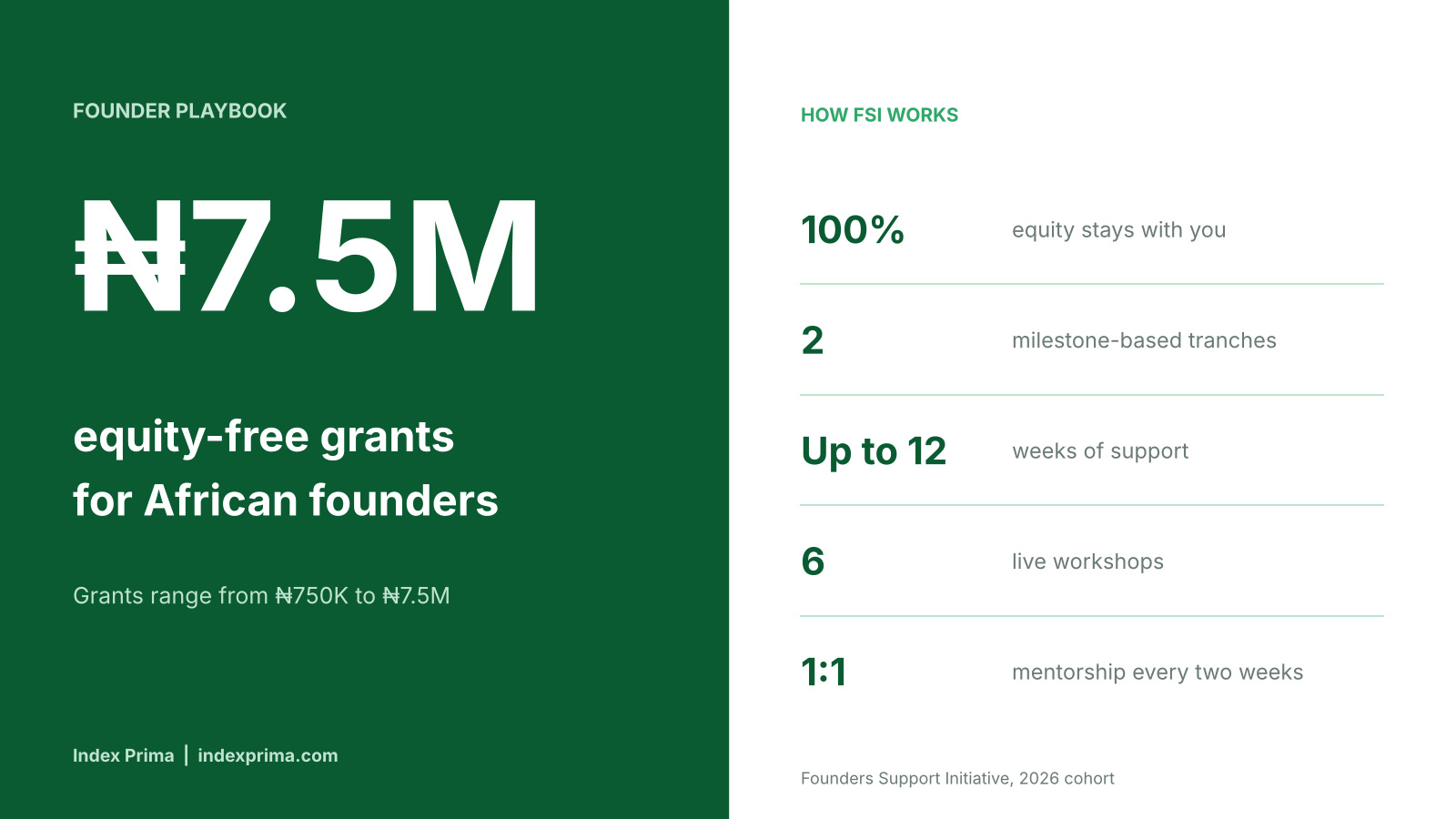
FSI backs early-stage African founders with non-dilutive grants, mentorship and training. “Non-dilutive” means you keep all your equity. The grants are paid in naira, and non-Nigerian founders receive theirs in local currency. According to FSI’s listing, grants range from ₦750,000 to ₦7,500,000, depending on the category. Examples include youth, women in business, and innovation and tech. The 2026 call ran from 10 May to 31 July. The first cohort began in September, and FSI now offers a waitlist for future cohorts.
The case for this kind of money is easy to see. A young company with little revenue often has two poor choices. It can sell equity early, or it can borrow when interest rates are high. A grant avoids both. It gives a founder room to test a product, find customers and build proof, without a cap table to untangle later.
Here is how FSI describes the programme. It is a sprint of up to 12 weeks that blends funding, mentorship and training. Money comes in two tranches, and each is tied to milestones. That means founders must show progress to receive the rest. Each founder gets one-on-one mentorship every two weeks and joins six live workshops on product development, go-to-market and fundraising. The mentors include experienced founders, operators and ecosystem leaders.
The rules for who can apply are wide. Founders and entrepreneurs aged 18 or older, building in Africa for African markets, can apply. A registered company is not required, though early traction helps. FSI says it wants ambitious founders from the idea stage onward, including first-time founders, students and professionals ready to go full-time. Women and tech-enabled founders are strongly encouraged. Sectors include technology, agriculture, health, education, climate, finance and the creative industries.
The first call drew strong interest. According to FSI, 879 people started an application, and 298 paid the ₦1,000 application fee and went through to review. That is about one in three. The lesson is plain: starting an application is easy, and finishing one takes commitment. FSI says the form takes 10 to 15 minutes. It asks about your startup, the problem you solve and how funding would help you grow.
How does FSI compare with other grants? Look at the Federal Government’s iDICE Startup Bridge, run by the Bank of Industry. Its first Founders Lab drew more than 13,000 applications and admitted 185 founders. After a 12-week programme, 50 of them won ₦5.7 million each, for a total of ₦285 million. Ten top performers then received a top-up of ₦4.275 million each, which brought their total to about ₦10 million. Funding depended on performance in the programme, not just attendance. A second cohort of 200 innovators has already started.
Both programmes follow the same pattern. Founders earn the money by doing the work, in a short and structured period. That is a good sign for the field. It rewards builders, not just good pitches.
If you plan to apply to the next round, start now. Write down the problem you solve and who has it. Gather any proof of demand, such as pilot customers, sales, waitlists or letters of intent. Plan how you would spend a grant in 12 weeks, and what you would measure. Call-for-application guides note that reviewers look for clarity and impact, so show how the money would make your business measurably stronger.
Why it matters: Most African startups never reach a venture round. Many stall before they can prove their idea, and early equity can cost founders control for years. Local-currency grants that come with coaching fill a real gap. They give founders a way to build on their own terms. Programmes like FSI and iDICE also give a clear signal to funders that early-stage African founders are worth backing.
What to watch next: the date for FSI’s next call, how first-cohort founders perform, how large the grants become, and whether more programmes pay out in local currency.
Sources: Founders Support Initiative programme page and application details, as reported by Tolulope Bamiloye; Founders Support Initiative; FSI 2026 cohort overview at utibeetim.com; WithinNigeria on the iDICE Startup Bridge.
A note for startup founders: Don’t practice on investors. Practice on AI first. RaiseReady by Index Prima is an AI fundraising simulator for African founders: upload your pitch deck, get a readiness score and face a tough AI investor before the real meeting. Find this post, and every post we publish, at raiseready.indexprima.com.