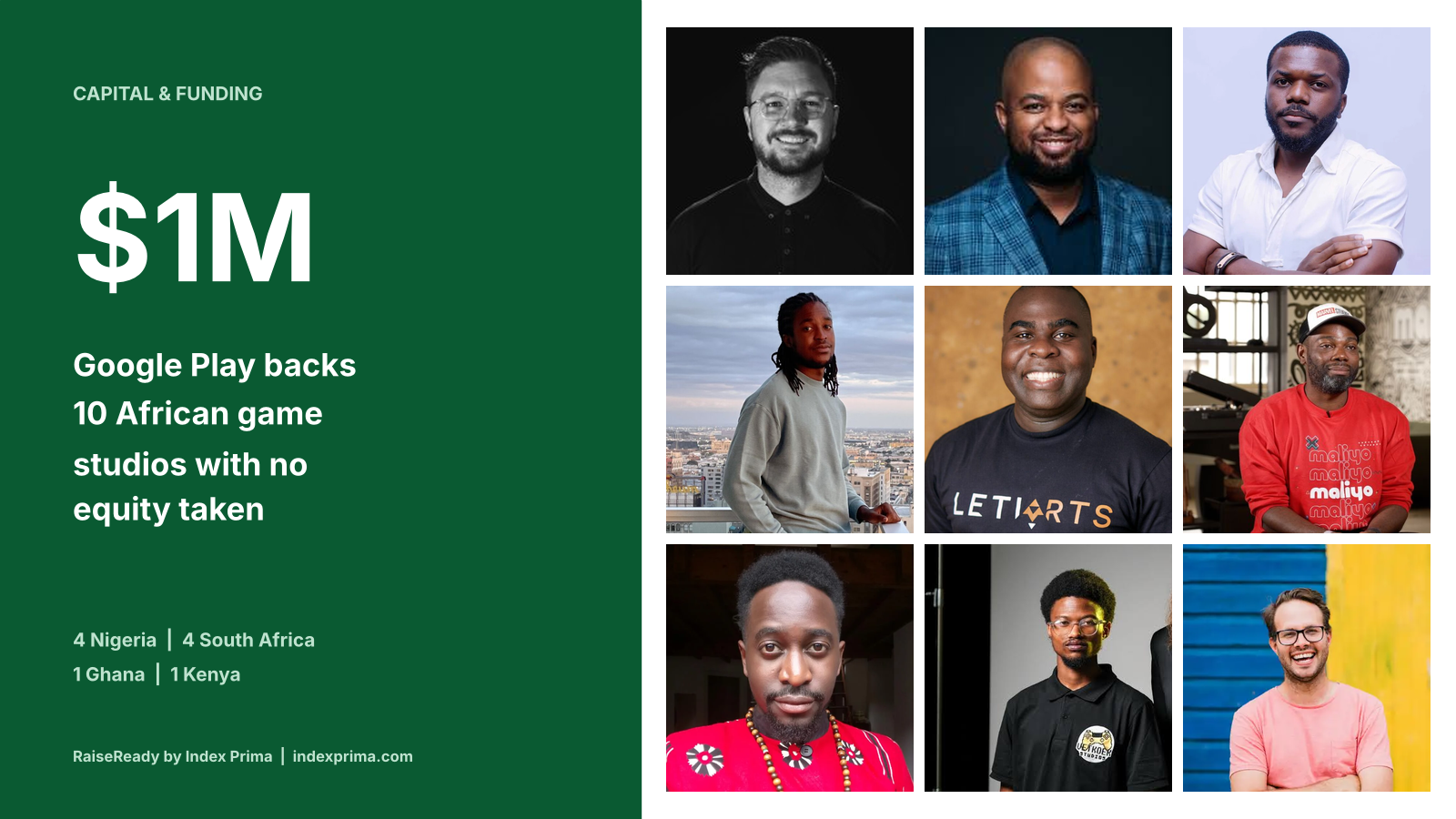
Google Play has picked the first 10 African indie game studios for its Indie Games Fund, and none of them gives up a share of their company. Four are from Nigeria, four from South Africa, one from Ghana and one from Kenya.
The fund totals $1 million. Each studio gets a share of non-dilutive money, which means no equity is taken, plus one-on-one mentorship from Google Play specialists, commercial and growth resources, and technical support from Unity. The announcement came on 28 October, after applications opened in July. It lands at a moment when African games are suddenly hot, with a viral Nigerian browser game and an African battle royale both announcing funding within weeks.
Who made the list? The studios, their games and their home countries are below.
| Studio | Country | Game | What it is |
|---|---|---|---|
| Clockwork Acorn. | South Africa. | Jetstream. | Puzzle game with 100+ levels. |
| Deluxe Entertainment Studios. | Nigeria. | Rasta Santa. | 2D action game set in Lagos. |
| Disputed People. | South Africa. | Mitts and the Divine Recipes. | 3D cooking adventure from African myth. |
| Fer Factor. | Nigeria. | Chore Master. | Cosy cleaning game. |
| Gazuntype Entertainment. | Nigeria. | Go North. | Story-driven maze adventure. |
| Leti Games (Leti Arts). | Ghana. | Sweave. | Rhythm game inspired by weaving. |
| Maliyo Games. | Nigeria. | Safari City. | Match-3 town renovation game. |
| Studio Bo. | South Africa. | Idle Sands. | 2D idle clicker. |
| Vetkoek Studios. | South Africa. | Taxi Ranked. | Driving game about minibus taxis. |
| Weza Interactive. | Kenya. | Riziki. | Rhythm adventure set to Afrobeats and Amapiano. |
The group mixes veterans and newcomers. Leti Arts, founded in 2009 by Wesley Kirinya and Eyram Tawia, is widely seen as a pioneer of the African games industry. Maliyo Games, founded by Hugo Obi in 2012, runs the GameUp Academy to train talent and publishes research on the market. Weza Interactive was founded in 2017 by twin brothers Odongo George Ahere and James Ahere. At the other end, Fer Factor is a one-person studio run by Feranmi Oladosu, who taught himself game development on YouTube at 15. Gazuntype is also a solo effort, led by Tade Ajiboye.
Now the money. Google has not said how much each studio gets. Reports say awards range from $50,000 to $200,000, and that studios must publish on Google Play and join Google Play Pass, the subscription service, on a non-exclusive basis for two years. On our sums, $1 million across 10 studios averages $100,000 each. Non-dilutive does not mean without conditions. The studios give up no ownership, but they commit their distribution to Google’s platform for two years. Many founders will take that deal gladly. Others will want to read the terms carefully. Google has also not said how many studios applied or how it chose the 10.
Compare that with what private investors did in the same few weeks. Vatar, the company behind the browser game Lagos Life, raised $500,000 at a $10 million valuation, days after the game launched on 1 October. Its investors include Flutterwave chief executive Olugbenga Agboola, Terra Industries chief executive Nathan Nwachuku and Mono chief executive Abdulhamid Hassan. Lagos Life drew more than 4 million players across 15 countries, with more than 200,000 online at its peak. And Rise of Fearless, a mobile battle royale inspired by Ethiopia’s victory at the Battle of Adwa in 1896, raised $1 million from Epic Edges Capital on a simple agreement for future equity. It has passed 15,000 downloads and is preparing a relaunch with a target of 100,000 players. Founder Kanessa Muluneh says she wants the game to keep its intellectual property in African hands and become a hub for local developers.
Put those numbers side by side. Vatar’s one angel round equals half of Google’s fund. Rise of Fearless’s round equals all of it. Two private deals in about a month are worth 1.5 times the whole programme. That is not a criticism of Google. It shows how small the pool of games money has been, and how fast a hit can move it.
The market behind them is real, though estimates vary. Carry1st and Newzoo forecast Africa’s games revenue at $1.98 billion in 2026, up 11.9%, with about 406 million players, and mobile making up about 82% of revenue. Another projection cited by African-Startups puts the 2026 market at roughly $2.29 billion, rising to $4.1 billion by 2031. The figures differ because the reports count different things. They agree on the direction. By the Newzoo-based figures, Egypt leads with $458 million in 2026, then South Africa at $263 million and Nigeria at $227 million. None of the 10 selected studios is from Egypt.
Why it matters: For years, African game developers have built on tiny budgets and hoped to find players abroad. A fund that pays studios without taking equity, and gives them access to Google Play’s tools and Unity’s technical help, lowers the cost of getting a game to a global audience. It also sends a signal to investors, who tend to follow big platforms. For founders, the lesson from Lagos Life and Rise of Fearless is that culture is an asset. Games built on local stories, places and music have an edge that foreign studios cannot copy. But hits are hard to repeat, and players do not pay easily. Studios will need to plan for ads, in-app purchases and local payment options from day one.
What to watch next: Whether Google publishes award sizes, application numbers and its selection criteria. Watch how many of the 10 games reach the Google Play charts, and whether the fund grows beyond $1 million or opens to more countries, including Egypt and French-speaking Africa. Watch whether Lagos Life keeps its players and turns them into revenue. And watch whether Rise of Fearless hits its 100,000-player goal after relaunch.
Sources: Rahul Raj, “Meet the 10 African gaming studios selected for Google Play’s $1 million Indie Games Fund,” African-Startups; Google on the Indie Games Fund 2026 selected studios; PocketGamer.biz on the 10 selected studios; Condia on the selected studios; Deal Street on Vatar’s $500K round; Condia on Rise of Fearless’s $1M raise; Games Industry Africa on the Newzoo and Carry1st market forecast.
A note for startup founders: Don’t practice on investors. Practice on AI first. RaiseReady by Index Prima is an AI fundraising simulator for African founders: upload your pitch deck, get a readiness score and face a tough AI investor before the real meeting. Find this post, and every post we publish, at raiseready.indexprima.com.