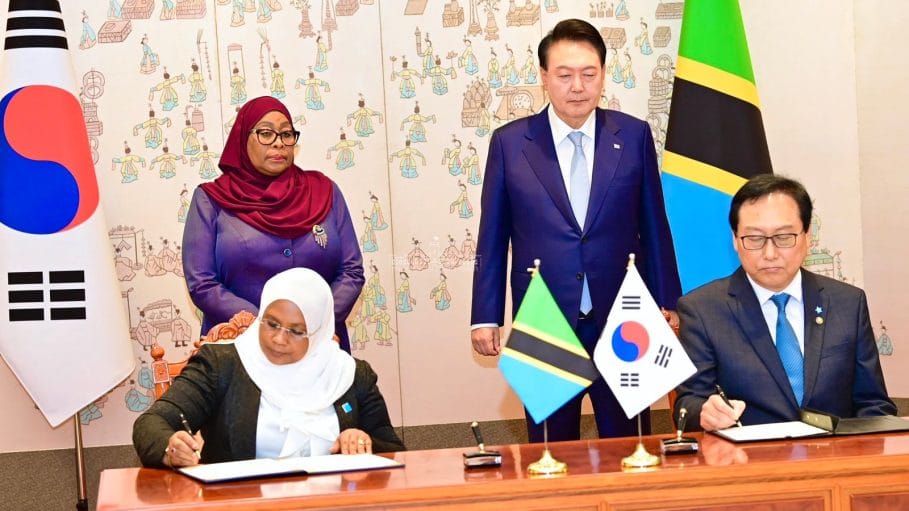
South Korea approved a $170 million concessional loan on August 23 to build Tanzania’s first dedicated AI and digital technology institute, marking the first artificial intelligence project South Korea has ever financed through its Economic Development Cooperation Fund. The approval came out of the EDCF’s 159th management committee meeting, chaired by the Minister of Finance and Economy and conducted in writing rather than in person, and it arrived alongside a broader revision of the fund’s own operating rules specifically aimed at expanding its AI-focused lending going forward.
The institute itself is being built from the ground up rather than bolted onto existing infrastructure. The loan covers construction of a full campus and classrooms, an AI lab, and equipment spanning robotics gear, drones, 3D printers, IoT devices, high-bandwidth AI processors, and the networking systems needed to run all of it. Four training programmes are planned: artificial intelligence, robotics, data analytics, and the Internet of Things, alongside curriculum development and ongoing funding for operating and maintaining the facility once it opens. What hasn’t been disclosed yet is almost as notable as what has, South Korea’s Finance Ministry hasn’t specified a location, a construction timeline, or how many students the institute will eventually be able to train.
There’s a structural detail in the financing worth being direct about. This is a tied loan, meaning procurement for the project is limited specifically to Korean companies, and South Korea’s own Finance Ministry has been explicit that the structure is designed to create business opportunities for Korean firms in AI, education technology, and construction looking to expand into African markets. That’s not a hidden agenda so much as standard practice for this kind of development financing, but it does mean the deal serves two audiences at once: Tanzania gets a domestically located training institute it wouldn’t otherwise be building at this scale, and Korean companies get a foothold in Africa’s AI sector with Tanzania’s government essentially guaranteeing them the contract. Tanzania is reportedly already planning follow-up projects modelled on this one, including additional training institutes and a large-scale data center, which would extend that pipeline of Korean business further still if those projects move forward.
For Tanzania, the institute slots into its Vision 2050 development strategy, which sets a national goal of reaching $7,000 in GDP per capita by 2050 and treats AI and digital industry growth as one of the pillars meant to get there. It’s also a significant jump in scale from what the country has invested in AI capacity so far. Tanzania has previously backed a scholarship programme in Johannesburg, an AI Xcelerate initiative launched with the International Organisation of Employers, a national digital learning strategy, AI integration into disaster management coordinated through the Prime Minister’s Office, and a partnership between the Strathmore Global Institute and the Africa Research Institute for AI. At $170 million, the Korean-backed institute is roughly eighty times the value of that Johannesburg scholarship programme alone, and more importantly, it builds training capacity physically inside Tanzania rather than sending students abroad and hoping enough of them return home afterward.
The deal also fits a broader shift already underway inside South Korea’s foreign aid strategy. The government has said it intends to grow the share of its official development assistance dedicated specifically to AI innovation in less developed regions, and it’s linking this EDCF loan to its Knowledge Sharing Program, a global AI hub initiative, and trust funds run through multilateral development banks, suggesting Tanzania’s institute is meant to be a template rather than a one-off. It also isn’t the first time Seoul and Dodoma have worked together this way. Back in 2020, the two governments signed a separate $300 million EDCF loan framework covering power grid substations, sewage treatment upgrades, land surveying equipment, and a bridge project, meaning this AI institute extends an already established development finance relationship rather than starting one from scratch.
Whichever way the tied-loan dynamics ultimately play out for Korean firms, the more consequential question for Tanzania is execution. A physical AI institute training people in robotics, data analytics, and IoT alongside core AI skills is a meaningfully different bet than a scholarship pipeline, because the expertise it builds stays rooted in the local economy from day one rather than depending on graduates choosing to come home. Whether Tanzania can actually staff, fill, and sustain an institute at this scale, once South Korea’s construction and equipment funding is spent, will determine whether this becomes the flagship Vision 2050 has been counting on or an impressive campus without enough trained instructors and enrolled students to match its ambition.