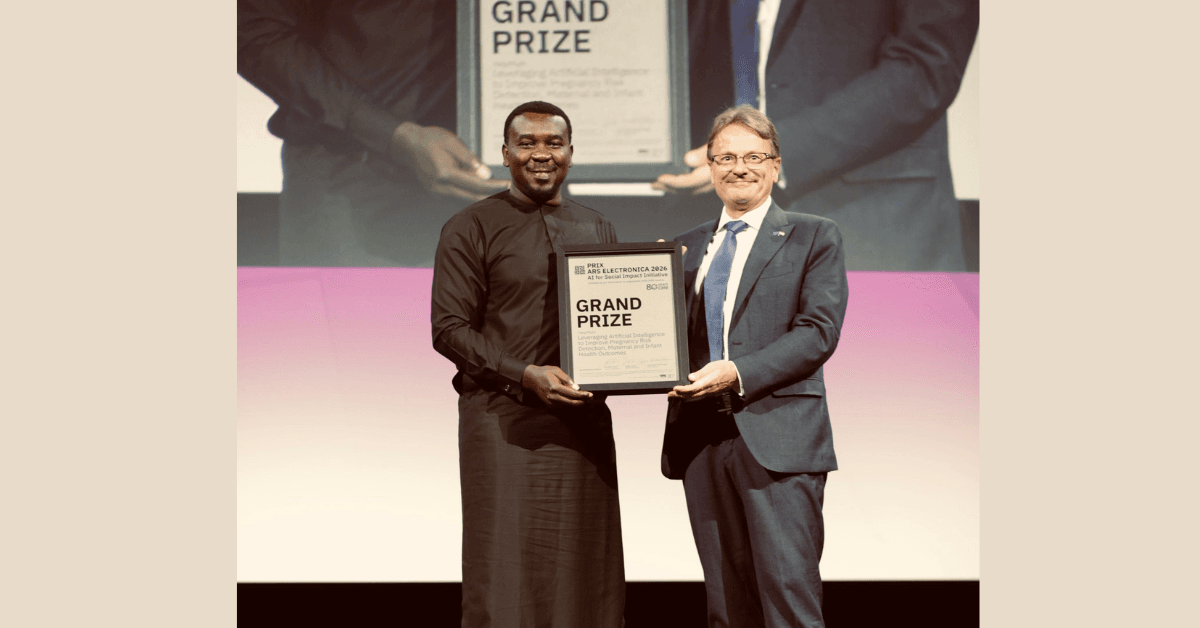
HelpMum Africa has become the first Nigerian organisation ever to win a Grand Prize at Prix Ars Electronica, often described as the Oscars of digital art, taking the top honour in the newly launched AI for Social Impact category. The award was presented in Linz, Austria, by Hannes Heide, a Member of the European Parliament, with HelpMum Africa represented on stage by Senior Backend Engineer Eniola Badmus, accepting on behalf of the full team.
The category HelpMum won is brand new this year, introduced through a collaboration between CARE Austria and Ars Electronica specifically to recognise organisations using artificial intelligence to create measurable social good. It’s positioned as the successor to the STARTS Prize Africa, which Ars Electronica awarded on behalf of the European Commission in 2023 and 2024, and it carries a deliberate regional focus, spotlighting projects originating from or developed in close collaboration with Africa, Latin America, South Asia, Southeast Asia, and the Middle East and North Africa. Ars Electronica has been explicit that these regions are treated as genuine sites of innovation and leadership in shaping technology’s future, not simply places where solutions built elsewhere get deployed. Across the category’s four total winners, two Grand Prizes worth €5,000 each and further Awards of Distinction worth €2,500 each, HelpMum’s win puts it among a small group selected from the entire submission pool of both the Prix Ars Electronica 2026 and the S+T+ARTS Prize 2026.
HelpMum was recognised specifically for a suite of AI-powered tools tackling maternal and infant mortality, one of the most persistent public health challenges across Nigeria and much of the continent. The suite includes MamaBot AI, a pregnancy support chatbot that gives expectant mothers accessible guidance throughout pregnancy, VaxAI, which helps track childhood immunisation to close gaps in vaccine coverage, and StratifyAI, which supports community health workers in identifying and prioritising at-risk cases. Crucially, these tools are delivered through WhatsApp, meeting users on a platform they already have installed and know how to use, rather than requiring a separate app download that tends to create its own adoption barrier in exactly the communities these tools are meant to reach.
Dr Abiodun Adereni, HelpMum Africa’s founder and CEO, framed the win as belonging to far more people than just the organisation’s staff. “This win belongs to our entire team at HelpMum Africa, the engineers, health workers, researchers, and field staff who show up every day and pour their hearts into this mission,” he said, extending that credit to “every community health worker and every mother we have served,” and describing the award as proof that solutions built in Nigeria, for Nigeria, can stand among the best in the world.
That claim carries real weight given who’s already backed HelpMum’s work. The organisation counts Google, Meta, the Patrick J. McGovern Foundation, the Sall Family Foundation, Merck, and Gavi, the Vaccine Alliance, among its funders, a list that spans major technology companies, a leading global vaccine alliance, and dedicated health philanthropy, suggesting HelpMum’s approach has already cleared serious due diligence from very different kinds of institutional backers well before this award.
The selection criteria behind the AI for Social Impact Initiative are worth noting too, since they explain why a health-focused AI suite from Lagos ended up recognised at what’s fundamentally a digital arts and technology festival. Judges weighted transparent development and use of AI heavily, alongside ethical, environmental, and democratic considerations, treating those as central to the prize rather than secondary criteria layered on top of pure technical achievement. Beyond the recognition itself, the initiative is designed to have a longer tail: national CARE country offices get the opportunity to engage directly with winning projects after the competition, assessing whether future cooperation could meaningfully extend the work’s reach.
For African health tech more broadly, a Nigerian organisation winning a Grand Prize at one of the more internationally recognised digital innovation platforms is a useful data point against a narrative that African-built AI tools are inherently less sophisticated than those coming out of better-resourced markets. HelpMum’s tools were built specifically around Nigerian maternal health realities and delivered through infrastructure Nigerians already use daily, and that specificity, rather than in spite of it, is precisely what an international jury judged to be world-class.