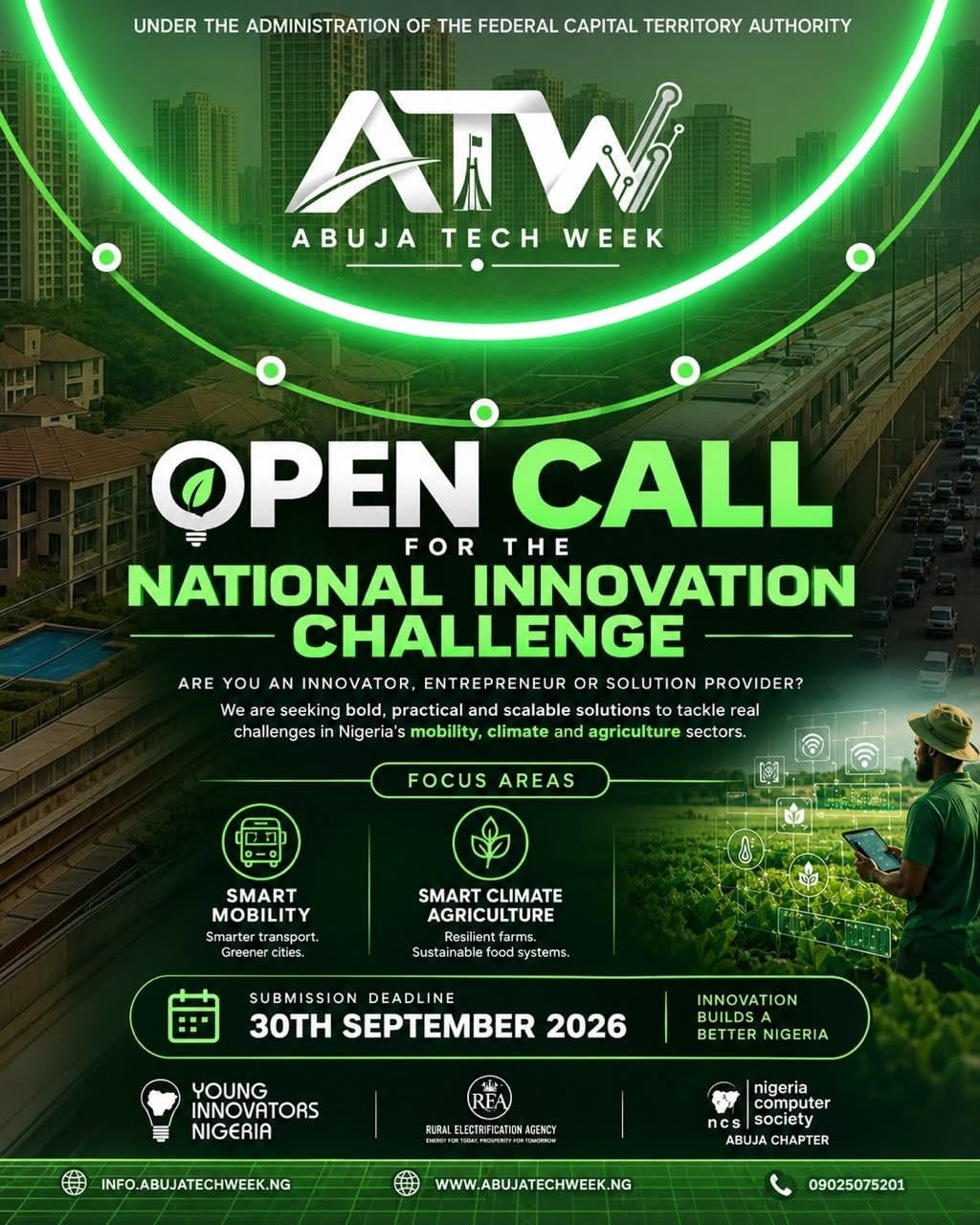
Applications are open for the National Innovation Challenge, a nationwide call from Abuja Tech Week inviting Nigerian innovators, entrepreneurs, and problem-solvers to submit bold, practical, and scalable solutions across two focus areas: smart mobility and smart climate agriculture. The challenge runs through September 30, with applications submitted directly via the event’s Luma page.
What the Challenge Is Actually Looking For
The smart mobility track spans traffic management and congestion, public transport systems, logistics and delivery optimisation, electric mobility, smart infrastructure and IoT, and mapping and navigation, a deliberately broad net covering both the software and physical infrastructure sides of how people and goods move through Nigerian cities. The smart climate agriculture track covers climate-smart farming solutions, smart irrigation and water management, agricultural data and predictive analytics, precision agriculture, sustainable food production, and agritech platforms improving digital market access. Between the two tracks, the challenge is effectively targeting two of the sectors where Nigeria’s infrastructure gaps translate most directly into everyday economic friction, getting people and goods around efficiently, and getting food produced and sold efficiently.
Part of a Much Larger Event Than the Challenge Alone
The National Innovation Challenge isn’t a standalone competition, it’s a component of the broader Abuja Tech and Digital Economy Week, which this year carries the theme “Energising Smart Mobility: Powering Cities of the Future,” a direct match to the challenge’s own mobility focus area. The full event is expected to draw at least 7,000 delegates, spanning policymakers, investors, startups, and development partners, and will feature an exhibition, an Investor Deal Room, and an investment forum covering smart mobility, clean energy, artificial intelligence, cybersecurity, and digital infrastructure. That scale matters for anyone deciding whether to apply: this isn’t a small campus hackathon, it’s a national event explicitly designed to put innovators in front of the kind of investor and policymaker audience that can actually move a promising prototype toward real deployment.
What Winners Actually Get Beyond Recognition
Andrew Abu, Chairman of the ATDEW Steering Committee, has said selected innovators from the National Innovation Challenge will gain access to technology infrastructure and incubation support through a partnership with Abuja Technology Village, including mentorship, pilot opportunities, and commercialisation support at its Science and Technology Park. Abuja Technology Village’s own management has reportedly welcomed the collaboration and is working with the Steering Committee toward a formal partnership framework, which suggests this incubation pathway is meant to be a genuine, ongoing pipeline rather than a one-time prize attached to this year’s challenge specifically.
Why This Framing Matters
Abu’s own framing of the challenge’s purpose is worth taking at face value: Nigeria, in his words, has no shortage of innovative young people, and the real gap sits in the bridge between ideas, infrastructure, investment, deployment, and scale. That’s a fair diagnosis of a pattern that shows up repeatedly across Nigerian innovation competitions, strong ideas surfacing at hackathons and challenges that then struggle to find the infrastructure, capital, or commercial pathway to actually become working businesses. By explicitly tying the National Innovation Challenge to Abuja Technology Village’s incubation infrastructure and the Investor Deal Room running alongside the wider event, this challenge is at least structurally designed to address that specific gap rather than end with a prize ceremony and no clear next step for winners.
How to Apply
Applications close September 30, 2026, and can be submitted through the challenge’s Luma page. More information about Abuja Tech Week and the organisations behind it is available at abujatechweek.ng.
Why It’s Worth Watching
Nigeria runs no shortage of innovation challenges in a given year, several with considerably larger headline cash prizes than this one discloses. What distinguishes this challenge is less the competition itself and more the infrastructure it’s explicitly wired into, a national event with real investor presence, a formal incubation partnership with an established technology park, and a stated focus on two sectors where working solutions have obvious, immediate commercial and public demand. Whether that structural advantage actually translates into more winners building lasting companies, rather than simply collecting a credential, will depend on how seriously the Abuja Technology Village partnership gets implemented once the challenge itself concludes.