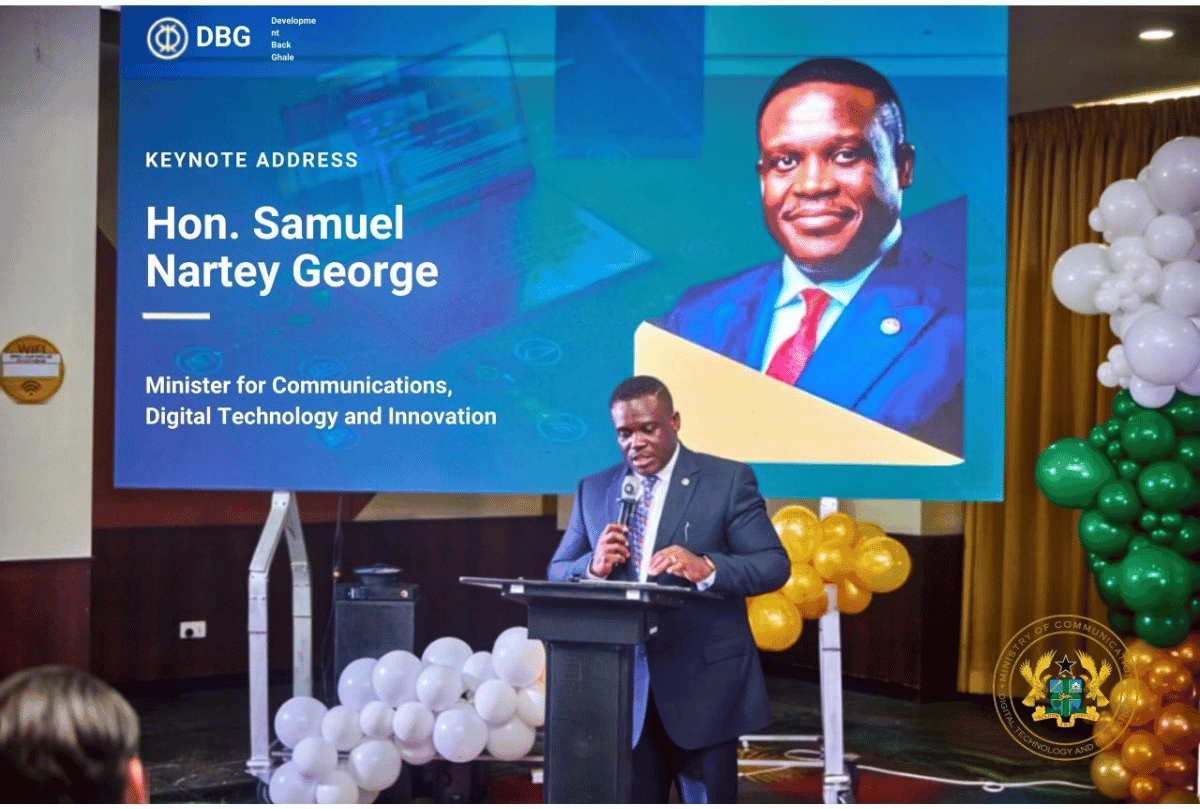
Ghana’s Minister for Communication, Digital Technology and Innovations, Samuel Nartey George, used a Development Bank Ghana roundtable in Accra to argue that Ghana’s technology sector has outgrown the financing tools built for traditional businesses, and that the country’s digital progress will stall without a deliberate shift toward capital structures suited to how tech companies actually operate. The event, held under the theme “From Connectivity to Capital: Unlocking Finance for Ghana’s ICT Sector,” brought together financiers, investors, engineers, entrepreneurs, and ICT businesses to work through exactly that gap. George’s own framing of the stakes was blunt: “Connectivity without capital is a road half-built.”
What Ghana Has Already Built, and What Comes Next
George was clear that Ghana has made real, substantial investment in the physical layer of its digital economy, fibre infrastructure, broadband, mobile connectivity, and digital services. The problem isn’t that foundation, it’s what has to be built on top of it. He argued the next phase of Ghana’s digital development depends on considerably heavier investment in data centres, cloud infrastructure, cybersecurity, software development, and fintech, the kind of higher-value digital infrastructure and services that connectivity alone doesn’t automatically produce. Ghanaian companies are already building in exactly these areas, alongside artificial intelligence, agritech, healthtech, education technology, logistics, and digital commerce, but George said many of them are being held back by financing structures that were never designed with their businesses in mind.
Why Conventional Financing Doesn’t Fit Tech Businesses
The core problem George pointed to is structural rather than simply a shortage of available money. Ghana’s financing system still relies heavily on conventional collateral requirements, physical assets, established revenue history, the kind of security a traditional bank loan is built around. Technology businesses typically don’t hold those assets in the same form, and their growth models look fundamentally different from a manufacturing or trading business a bank might be used to underwriting. George called for a shift toward tools that actually match that reality: greater use of venture capital, private equity, patient capital willing to wait longer for returns, blended finance combining public and private money, and guarantee and credit enhancement mechanisms that reduce the risk a lender takes on without requiring the collateral a young tech company simply doesn’t have.
DBG’s Own Diagnosis Backs This Up
Development Bank Ghana’s CEO, Prof. Randolph Nsor-Ambala, brought independent research to the same roundtable that reinforces George’s argument. A nationwide feasibility study DBG conducted identified four major barriers confronting ICT businesses specifically: financing, policy alignment, investor readiness, and business development support. Nsor-Ambala made a point worth sitting with directly: access to capital, while genuinely critical, isn’t the sector’s only problem, the structure of that financing matters just as much as whether it’s available at all. He warned explicitly against a one-size-fits-all approach to ICT financing, arguing instead for targeted instruments paired with stronger business development support to actually help companies become investment-ready in the first place, not just easier to lend to on paper.
The Government Initiatives This Is Meant to Build On
George tied the financing conversation directly to work already underway elsewhere in Ghana’s digital strategy. The One Million Coders Programme had recorded 141,954 registered accounts as of August 2026, a real, growing pipeline of digital skills. That sits alongside Ghana’s National Artificial Intelligence Strategy, running from 2025 to 2035, and a planned $250 million Artificial Intelligence Computing Centre meant to give the country genuine local AI infrastructure rather than relying entirely on foreign cloud capacity. George’s argument is that these investments only pay off fully if the businesses and talent they produce can actually access the capital needed to scale, framing the goal explicitly as moving Ghana from a country that mainly consumes technology built elsewhere toward one that produces, scales, and exports technology developed locally.
Who Actually Has to Move Together
Neither George nor Nsor-Ambala framed this as something one institution can fix alone. George called for stronger collaboration specifically between government, financial institutions, development finance institutions like DBG, investors, technology entrepreneurs, regulators, development partners, and academia, a genuinely wide coalition that reflects how many different pieces, funding structures, policy alignment, investor education, business support, actually need to move together for the financing gap to close in practice rather than just get discussed at another roundtable.
Why It’s Worth Watching
This roundtable is the latest entry in a broader pattern of Ghana treating its digital economy as unfinished business rather than a completed project, following the same government’s recent push on 5G spectrum licensing and its proposed overhaul of the school curriculum to include AI and coding. Connectivity, skills pipelines, and infrastructure investment all matter, but George’s central point is hard to argue with: none of it converts into scaled, competitive Ghanaian tech companies without financing tools built for how those companies actually grow. Whether this roundtable produces real new financing instruments or simply restates a well-understood problem is the question the next year of DBG’s actual lending activity will answer.