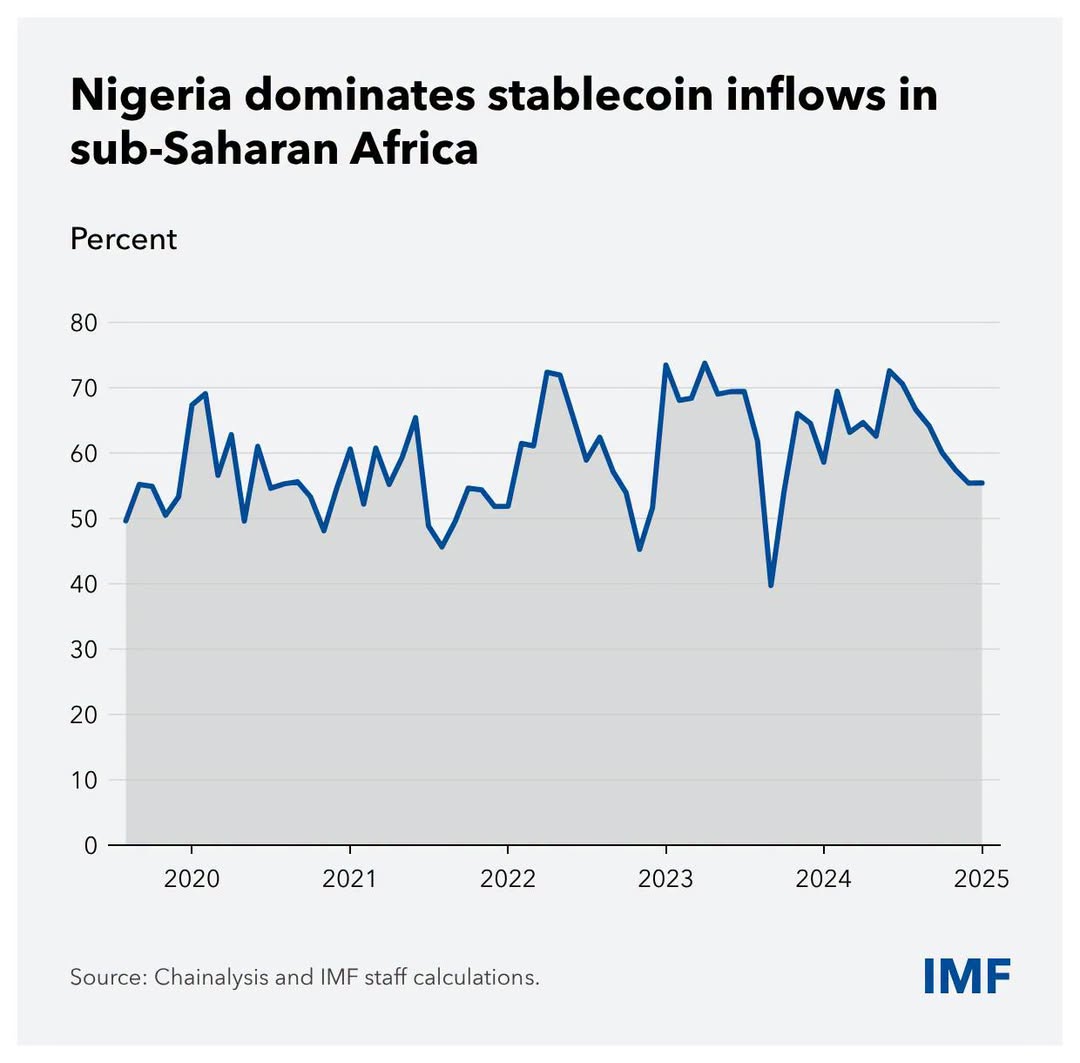
Nigeria is now sub-Saharan Africa’s leader in cross-border stablecoin payments, according to the International Monetary Fund’s latest Article IV assessment of the country. That’s not a marginal finding buried in a footnote. Nigeria received an estimated $59 billion in crypto-asset inflows between July 2023 and June 2024, ranked second globally on Chainalysis’s 2024 Global Crypto Adoption Index, and accounts for roughly 60% of all stablecoin inflows into sub-Saharan Africa going back to 2019. For a government that has spent years publicly restricting cryptocurrency activity, that’s a genuinely awkward number to sit with.
An Officially Restrictive Country With a Practically Widespread Habit
The contradiction at the centre of this story is worth naming directly. Nigeria’s central bank launched the eNaira, Africa’s first central bank digital currency, while simultaneously maintaining restrictions on private crypto transactions. And yet Chainalysis estimated that informal stablecoin usage in Nigeria hit $26 billion in 2024, driven largely by USDT used for import and export financing, activity happening well outside the CBN’s own preferred digital currency and largely outside formal oversight altogether. Nigerians and Nigerian businesses have simply built a parallel financial rail the regulatory system didn’t design, using tools that happen to work better than the ones the system officially sanctions.
Why the Math Actually Favours Stablecoins Here
The appeal isn’t abstract. The World Bank puts the average cost of sending $200 into sub-Saharan Africa at around 9% of the transaction value, well above the 6% global average, and stablecoins offer a real way around that markup for smaller, everyday transfers. Nigeria’s own recent economic history sharpened that appeal further. Sharp naira depreciation, high inflation, and constrained access to foreign exchange through 2023 and 2024 pushed demand toward dollar-linked assets that could function as both a currency hedge and a practical tool for paying suppliers overseas. It’s worth being precise, though, that stablecoins aren’t a strictly better deal in every case. For a large transfer, a $10,000 wire from the US to Nigeria costs roughly $130, about 1.3%, through a traditional bank, while the same transfer through USDT, once conversion spreads are factored in, can run closer to $242, about 2.4%. The cost advantage is real and substantial for smaller, high-frequency transfers, which is exactly where informal Nigerian usage has concentrated, not necessarily for every transaction size.
What the IMF Is Actually Worried About
The Fund’s concerns aren’t about stablecoins being inherently bad tools, they’re about what happens at national scale once enough of a country’s cross-border activity runs through dollar-denominated private assets instead of the local currency. The IMF frames this as a genuine monetary sovereignty risk: because stablecoins are typically denominated in US dollars, widespread use can resemble a digital form of dollarisation, reducing demand for the naira and weakening how effectively domestic monetary policy can actually transmit through the economy. There’s a financial integrity concern layered on top of that too, since the monitoring systems built for traditional financial intermediaries weren’t designed to capture stablecoin transaction flows, creating a real gap in anti-money-laundering visibility. And counterparty risk remains a serious, underappreciated problem industry-wide: hacks targeting digital asset bridge solutions account for close to 40% of all cryptocurrency value ever lost to hacking across the sector’s entire history. As Stable Sea CEO Tanner Taddeo put it, the finance executives actually deciding whether to adopt this technology tend to be conservative for good reason. They’re not buying into stablecoins because it’s innovative, they’re buying in to reduce risk, and that calculus only works if the underlying infrastructure is actually trustworthy.
The Industry Is Adapting Rather Than Fighting It
What’s notable is how quickly African mobile money operators have shifted their own posture. Rather than treating stablecoins purely as a competitive threat to existing mobile money rails, operators across Africa and the wider MENA region have increasingly started integrating licensed stablecoin rails directly into their own products, treating the technology as a new revenue line rather than an existential risk. That shift is showing up at the policy level too. The UN Economic Commission for Africa convened a dialogue in August 2026 specifically examining how stablecoins and tokenised money could support cross-border payments and deeper regional financial integration across the continent, while working through the same infrastructure, liquidity, regulatory, and consumer protection questions the IMF has been raising.
The Regulatory Move That Actually Makes Sense of All This
Read against this backdrop, Nigeria’s own recent move to apply a 5% withholding tax to digital asset platforms, formalising crypto income under the same tax regime as any other business earnings rather than a separate, lighter-touch category, looks less like an isolated tax policy decision and more like an attempt to finally put some formal structure around an economic activity that had already scaled well past what informal tolerance could sustainably manage. You can’t meaningfully tax, monitor, or regulate $26 billion in informal stablecoin flows by pretending the activity doesn’t exist. Bringing platforms into a formal withholding framework is one of the more realistic paths toward actually seeing what’s moving through the system, even if it does nothing to resolve the deeper dollarisation and monetary sovereignty questions the IMF is flagging.
Why This Matters Beyond Nigeria
Global forecasts put stablecoins on track to capture somewhere between 12% and 30% of the entire global remittance market by 2030, depending on how quickly regulatory frameworks and on-ramp infrastructure mature. Nigeria isn’t waiting for that future to arrive. It’s already living inside an early, largely informal version of it, with regulators now racing to build the policy infrastructure to match a level of adoption that outpaced their own restrictions years ago. Whatever Nigeria’s central bank decides to do next, the more instructive lesson for the rest of the continent may already be settled: when a financial tool solves a real, expensive, everyday problem better than the formal system does, adoption doesn’t wait for permission.