There’s a specific instinct that kills more African startups than bad ideas ever do: the belief that owning your entire stack, infrastructure, logistics, technology, all of it, is what separates a serious company from a shortcut. In capital-abundant markets, that instinct is sometimes affordable. In African markets, where a Series A can be the difference between survival and shutdown, it’s frequently a death sentence. Look closely at the startups actually pulling off durable pivots and expansions across the continent right now, and a very different pattern shows up again and again: the smartest ones aren’t building every missing piece themselves. They’re finding it already built, and partnering with or buying whoever built it.
Case Study One: Medwaka Couldn’t Afford Ambulances, So It Stopped Trying to Own Them
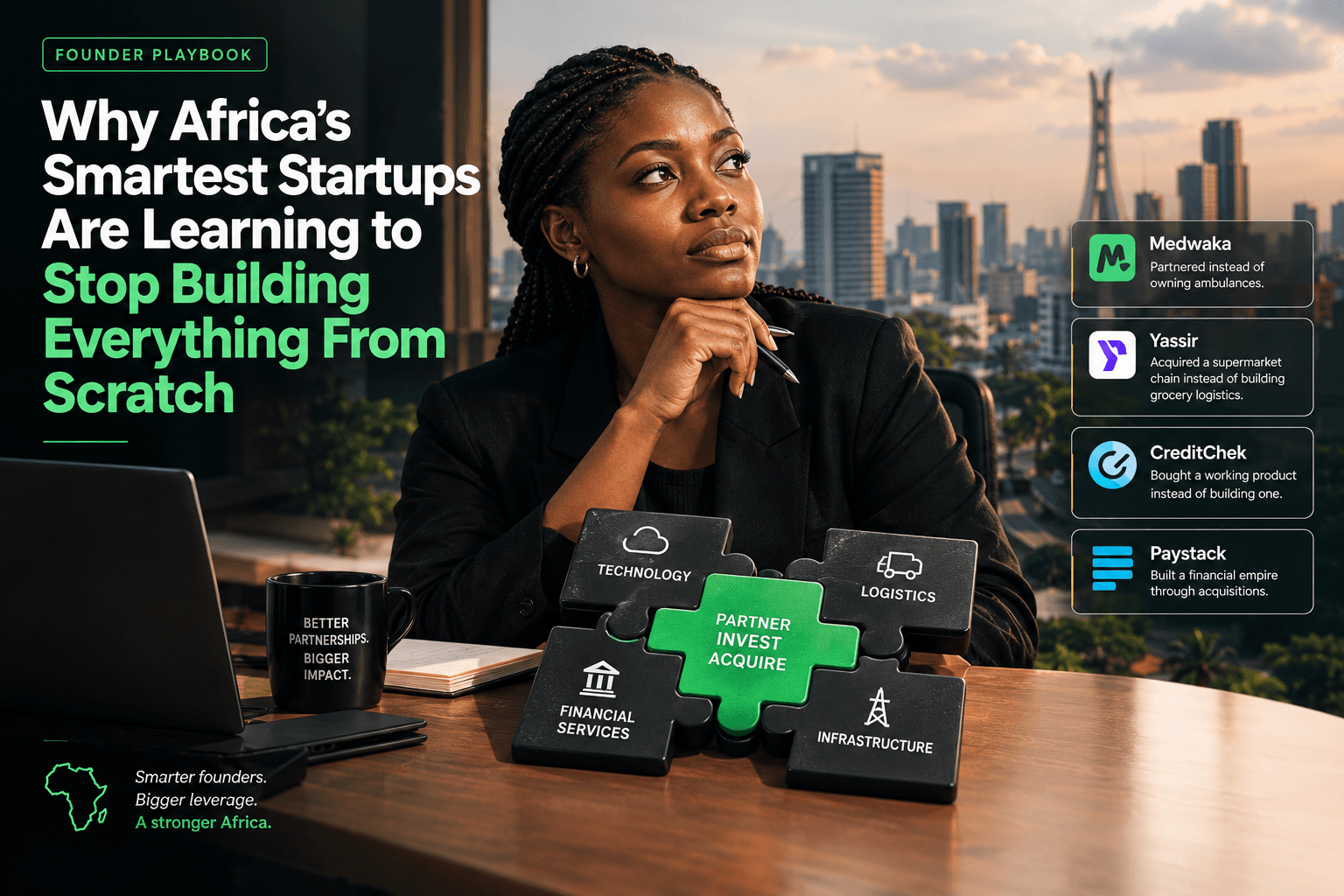
Nigerian health-tech startup Medwaka set out in 2024 with a genuinely ambitious vision: a 911-style emergency response system for a country that doesn’t have one. The plan required an ambulance fleet, and ambulance fleets cost money early-stage startups simply don’t have. Medwaka’s founders spent months trying to make that model work anyway, either buying their own vehicles or depending on hospitals’ existing ambulances, and ran into exactly the wall you’d expect: inconsistent availability, and a company perpetually stretched by trying to own physical infrastructure equity investors weren’t going to fund at that stage. The pivot that actually worked was abandoning the ownership model entirely. Rather than build a parallel emergency infrastructure system, Medwaka repositioned itself as a layer that strengthens the emergency response systems already in place, partnering with private hospitals, HMOs, NGOs, and community organisations instead of competing with them for the same physical assets. The results tell you the pivot was correct: the company’s directly-trained first responder count barely moved after the shift, from 10 to 11, while emergency requests facilitated through its platform and partner network grew to more than 550. Nearly all of Medwaka’s growth since the pivot has run through infrastructure it doesn’t own and never had to pay for.
Case Study Two: Yassir Bought a Supermarket Chain Instead of Building Grocery Logistics From Zero
When Jumia exited Algeria in February 2026, it left behind exactly the kind of gap that tempts founders into an expensive mistake: building an entire online grocery logistics operation from scratch to fill it. Algerian super-app Yassir did something considerably smarter. One month after Jumia’s exit, Yassir acquired Uno, Algeria’s leading grocery chain, picking up 23 existing stores, an established supply chain, and years of market relationships in a single deal rather than spending years and enormous capital trying to replicate any of it independently. The acquisition gave Yassir instant market leadership in a segment where competitors have struggled for years precisely because building grocery logistics and consumer trust from nothing is genuinely hard in a market still reliant on cash-on-delivery payments. Yassir bought its way past the hardest part of the problem instead of solving it the slow way.
Case Study Three: CreditChek Bought a Working Product Instead of Building One
Nigerian credit infrastructure company CreditChek wanted to move beyond pure credit assessment into offering a complete lending stack, credit assessment, lending decisions, and loan management, connected end to end. Building loan management and core banking software from scratch is a serious technical undertaking on its own. Instead, CreditChek acquired Algosys, a two-year-old Ugandan startup that had already built exactly that software and already had it running across 22 financial institutions. CreditChek’s own leadership has been explicit that the goal isn’t deploying a single product unchanged everywhere, but the acquisition itself is the real lesson: rather than spending a year building loan management infrastructure from zero, CreditChek bought a company that had already proven the product worked, along with the customer relationships that came with it.
Case Study Four: Paystack Assembled a Financial Empire Through Acquisitions, Not Ground-Up Builds
Perhaps the clearest example of this pattern at scale is Paystack, Nigeria’s largest payments processor. In the space of eighteen months, Paystack acquired three separate fintechs: Ladder Microfinance Bank, which handed it an actual banking licence; Brass, a business banking startup folded directly into its microfinance bank; and Allawee, a card-issuing infrastructure company whose technology slotted directly into Paystack’s growing stack. None of these were announced with fanfare. Paystack quietly assembled what amounts to a full-stack financial services group, payments, banking, card infrastructure, consumer transfers, largely by buying working pieces rather than building most of them internally, a strategy that let it move at a pace organic development alone couldn’t have matched.
Why This Pattern Keeps Showing Up
The logic underneath all four cases is the same, even though the companies, countries, and sectors are completely different. African markets are capital-constrained in ways that make years-long infrastructure builds genuinely risky bets, and in nearly every sector, someone smaller has usually already built the specific missing piece you need, often well, often cheaply relative to what building it yourself would cost, and often desperate for the capital or distribution a larger partner can provide. The startups getting this right aren’t lacking ambition. They’re being precise about where ambition should actually go: toward the parts of the business that are genuinely differentiated, and away from infrastructure that already exists and simply needs to be connected to, rather than replicated.
The Practical Question to Ask Before You Build Anything
Before committing capital or months of engineering time to building a new capability, the more useful question isn’t “can we build this.” It’s “does something like this already exist, run by a smaller or earlier-stage team, that we could partner with, invest in, or acquire instead.” That question won’t always lead to a partnership or acquisition, sometimes the thing you need genuinely doesn’t exist yet, or owning the infrastructure really is your defensible moat, the way Terra Industries’ bet on owning its own manufacturing capacity for autonomous defence systems is a deliberate exception to this pattern, not a contradiction of it. But for most African founders solving problems that other founders elsewhere have already partially solved, the discipline to ask that question first, before defaulting to building from scratch, is turning out to be one of the more reliable predictors of which companies actually survive long enough to matter.