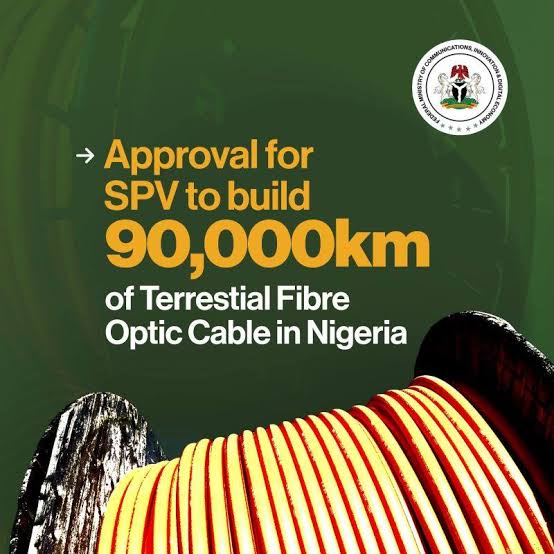
Nigeria has set up Bridge Open Access, the company that will build 90,000 km of new open-access fibre, backed by about $800 million from the World Bank, the African Development Bank and the European Bank for Reconstruction and Development. The cables are only half the test, because Africa already has coverage that people do not use.
The GSMA’s Digital Africa Index 2026 says 92% of Africans live under mobile broadband, yet only 28% use mobile internet on their own devices. That leaves a 64% usage gap, which is the problem new fibre cannot fix alone. Bridge OA will add wholesale capacity to sell to operators, and its lenders have tied their money to open-access rules, published prices and kilometres laid.
| Item | Detail |
|---|---|
| Project. | Project BRIDGE, run by Bridge Open Access (Bridge OA), a company set up in August 2026. |
| Build. | 90,000 km of new open-access fibre, reaching all 774 local government areas. |
| Cost. | About $2 billion. One report puts the appraised cost at $1.6 billion. |
| Sovereign loans. | About $800 million: World Bank $500 million, AfDB $200 million, EBRD $100 million. |
| Private money. | At least $1.1 billion expected. Not yet closed. |
| Ownership. | Government 25% to 49% through MOFI. Private investors at least 51%, with operational control. |
| Public sites. | 38,800+ schools, 16,900+ health facilities and 3,400+ local government offices, per the World Bank. |
| Not stated. | Private investors, wholesale prices and the construction start date. |
Backbone fibre is the cable that links cities and networks. Wholesale fibre lets mobile firms and internet providers rent capacity, and open access means they all pay on equal terms. Bridge OA plans to take Nigeria’s backbone from about 30,000 or 35,000 km, depending on the source, to about 120,000 or 125,000 km. It also plans cross-border links to Benin, Cameroon, Niger and Chad. Bosun Tijani, the communications minister, calls the new company “the institutional platform” needed to bring in strategic investors. Government will hold its stake through the Ministry of Finance Incorporated, and private investors will run the firm.
The money comes with strings, and that is where the story gets interesting. The World Bank’s $500 million is paid by results. Funds come only after set steps: the company is formed with partners chosen in a fair contest, at least 5,000 km of fibre is built, then 25,000 km. After that, the company must launch wholesale open-access service and publish a “reference offer” on prices and access terms. TechCabal reported the milestones in November 2025. Our reading is that this offer is the most useful rule in the plan. A published price list lets operators, regulators and reporters check whether capacity is sold fairly. It speaks to a worry in the TechAfrica News edition: private investors need returns, so wholesale prices could stay high. A public offer does not set prices, but it makes them visible. BusinessDay reports a 2030 goal of a 17% fall in wholesale bandwidth prices.
Build speed is the next test. BusinessDay calculates that Nigeria must lay about 62 km a day on average, and 80 to 90 km a day at the peak, across six construction zones. The schedule runs into the first nine months of 2030, and Tijani said fibre laying should start “in a few weeks”. TechAfrica News reports an October 2026 start and a 2028 finish. The BusinessDay schedule runs about two years longer. Right of way is a big hurdle. More than 11 states have waived charges, yet local levies and slow permits remain. Fibre cuts are another. BusinessDay cites 155,397 cuts in April and May 2026, more than 54,000 of them linked to vandalism. The World Bank rates the programme’s overall risk as substantial.
By our sums, the sovereign money of $800 million plus $1.1 billion from private investors makes about $1.9 billion, close to the $2 billion headline. That means more than half the money must still come from investors who have not been named. The World Bank’s lists of sites, 38,800 schools, 16,900 health facilities and 3,400 local government offices, add up to about 59,100 public sites, which matches the 2030 goal BusinessDay reports. The TechAfrica News edition cites more than 200,000 public institutions, and the federal project page says about 216,871 institutions lack reliable internet. Those are the people who need service, not the number the build will connect by 2030.
The usage gap is where fibre meets real life. By our sums, 28% use against 92% covered means only about three in ten people under a signal use the internet. The GSMA lists high device costs, weak skills, little useful local content and unreliable service as the causes. It also says only nine of 54 African countries charge neither special taxes nor import duties on phones. South Africa dropped a 9% excise duty on smartphones under R2,500 in April 2025, and monthly entry-level sales rose 80%, from about 250,000 to about 460,000, by February 2026, per the GSMA. Caroline Mbugua of the GSMA told TechAfrica News that “AI will not happen if we don’t address smartphone affordability.” The Index does not say what Nigeria charges on phones, so we make no claim on that.
There is some good news in the design. The AfDB says its $200 million loan, called D-VIBE, also covers cheaper devices, large-scale skills training, support for digital platforms, cybersecurity and competition policy. So the lenders see the problem. The open question is whether those parts move as fast as the cables. The Nigerian government has also said it will train thousands through the Digital Bridge Institute, and the BusinessDay report says 37,000 people are meant to get digital literacy training by 2030, 60% of them women.
Why it matters: Nigeria is spending public money and private capital to add capacity, and what people pay and use will decide whether it pays off. Startups, schools and clinics need cheap, steady links, and a published wholesale offer gives them a chance to compare. The plan will help most if device prices, skills and local services improve at the same time.
What to watch next: who the private investors are, and when their money closes. Watch for the published reference offer and the first wholesale prices. Watch the first 5,000 km and whether construction starts on time. Watch how many states keep right-of-way fees low. Watch fibre cuts and how quickly they are repaired. And watch whether Nigeria cuts taxes on entry-level phones.
Sources: TechAfrica News, “How Ownership Structure and Right-of-Way Execution Will Decide the Real Impact of Nigeria’s $2 Billion Fibre Buildout”, 26 November 2026; Federal Ministry of Communications, Innovation and Digital Economy, “What is Project BRIDGE”; TechCabal, “World Bank ties Nigeria’s Project BRIDGE $500m loan to strict milestones”, 3 November 2025; TechCabal, “Nigeria takes 49% stake in World Bank-backed $2bn fibre project”, 30 January 2026; TechCabal, “Nigeria lands $126m European backing for national fibre project”, 26 February 2026; Nairametrics, “FG secures $200 million AfDB loan for 90,000km fibre project”, 11 April 2026; Connecting Africa, “Nigeria’s Project Bridge moves to implementation phase”, 11 August 2026; Techpoint Africa, “Nigeria incorporates Bridge OA to run its 90,000km fibre build”, 12 August 2026; BusinessDay, “BRIDGE: Nigeria must lay up to 80km of fibre every day to meet 2030 digital economy goal”; GSMA, “Africa’s Digital Progress Accelerates, but 64% Usage Gap Shows Next Challenge for Policymakers”, 18 November 2026.
A note for startup founders: Don’t practice on investors. Practice on AI first. RaiseReady by Index Prima is an AI fundraising simulator for African founders: upload your pitch deck, get a readiness score and face a tough AI investor before the real meeting. Find this post, and every post we publish, at raiseready.indexprima.com.