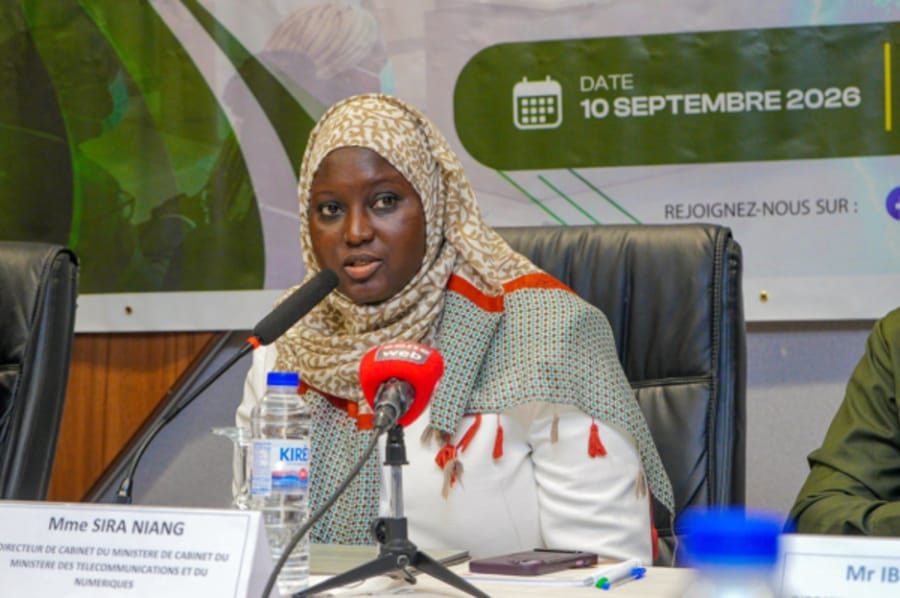
Senegal moved its national digital skills strategy from paper to practice on September 10, when a validation workshop in Dakar signed off on a National Digital Training Plan for the country’s civil service. The session was co-chaired by Ibrahima Dieng, Director General of the Public Service, representing the Minister of Public Service, Labour and Public Sector Reform, and Sira Niang Sy, Chief of Staff to Minister of Telecommunications and Digital Affairs Samba Diouf, and brought together representatives from ministerial departments, public administrations, HR and training units, and the technical and financial partners already involved in digitising Senegal’s public administration.
The plan’s guiding philosophy is worth stating plainly, because it shapes everything about how it will actually be rolled out. Dieng was direct that the goal isn’t training in digital skills for its own sake, but training that helps civil servants work better, administer better, serve citizens better, and meet their expectations more effectively. That means the programme is explicitly designed to reach every level of the administration at once, decision-makers, operational staff, managers, and the human resources and information systems officials who keep the machinery running, rather than treating digital training as something aimed only at junior technical staff. Niang Sy reinforced the same point from a different angle: the plan isn’t trying to turn every civil servant into an IT specialist, it’s built to give each employee the specific digital skills relevant to their own role and responsibilities.
In practice, that means the curriculum spans digital tools, data management, artificial intelligence, cybersecurity, information systems, digital public services, and new ways of working shaped by the broader digitisation of administrative processes. A finance ministry employee and a frontline service officer aren’t expected to walk away from this with identical skill sets, they’re expected to walk away equipped for what their specific job actually requires.
The plan sits inside two larger frameworks Senegal has already committed to publicly: the Senegal 2050 national transformation agenda and the New Technological Deal, the digital transformation strategy launched in February 2025. Both explicitly name state modernisation and human capital development among the country’s top national priorities, and this training plan is the concrete mechanism meant to deliver on the human capital half of that equation specifically within government itself. There’s real budget behind the broader ambition too. Senegal’s telecommunications ministry proposed a 38.7% increase to its 2026 digital budget, bringing it to CFA 81.06 billion, roughly $143 million, with the largest single share, CFA 33.8 billion, earmarked for digital sovereignty and funding that explicitly includes ICT training for civil servants among its stated priorities.
None of this guarantees smooth execution. Validating a national training plan is a meaningfully easier step than actually delivering differentiated, role-specific digital training across an entire public administration, especially one spanning everything from senior ministry decision-makers to operational staff processing citizen requests day to day. But the design choice to avoid a one-size-fits-all curriculum, tailoring content to what each function actually needs rather than running everyone through identical generic modules, is the right instinct for a programme this size, and it’s a meaningfully more thoughtful starting point than simply mandating a baseline digital literacy course across the board and calling the job done.