On paper, Nairobi’s startups raised $277 million in nine months, more than four times last year. Take out one electric-vehicle firm and the “boom” is flat.
The firm is Spiro. It raised $270 million this year, and it is based in Nairobi, so the money lands on Nairobi’s scoreboard. But Kenya’s other trackers show a country whose startup funding is slipping, not surging. This report looks at how one company can move a city’s numbers, what is left when you remove it, and what that means for founders raising money in East Africa.
Start with the headline. Tracxn’s nine-month report for 2026 credits Nairobi with $277 million, up from $61 million in the same period of 2025. That is a jump of about 354%, and it gives Nairobi 41% of the $684 million Tracxn counts across the continent. It is the biggest city on the list. The report also credits Nairobi with $270 million from Spiro, according to its city table. Do the sum. That leaves about $7 million for every other Nairobi startup combined. Spiro is about 97 cents of every dollar.
Tracxn’s own headline total counts Spiro at $215 million, not $270 million. The two figures do not fit neatly together, so here are both readings.
| Nairobi, Tracxn, first nine months | 2025 | 2026 | Change |
|---|---|---|---|
| As reported. | $61M. | $277M. | Up 354%. |
| Without Spiro at $270M. | $61M. | About $7M. | Down 89%. |
| Without Spiro at $215M. | $61M. | About $62M. | Up 2%. |
These sums are ours. Neither reading shows a surge. At best, Nairobi is flat. At worst, it fell sharply. The point holds either way. One company decides the story.
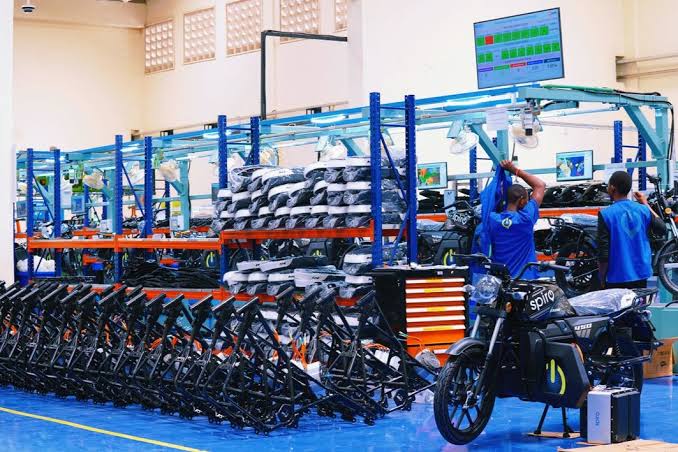
Who is Spiro? It builds electric motorcycles and runs battery-swap stations, where riders hand in a flat battery and take a charged one. TechCabal reported in October 2025 that its headquarters is in Nairobi. By then it held about 52% of Kenya’s electric motorbike market, with more than 8,000 electric motorcycles on Kenyan roads and 200 swap stations. It assembles bikes from imported kits in Kenya, Rwanda and Uganda. Its chief executive, Kaushik Burman, called a $100 million raise that month a step toward “a pan-African battery-swapping infrastructure.” Back then, its total debt and equity funding stood at $280 million.
Then came 2026. On 3 June, Spiro announced a $215 million equity round, backed by Impact Fund Denmark and Equitane, among others. Later in June, $55 million more from NewTrails Capital, a growth-stage fund based in Shanghai and Shenzhen with an office in Nigeria, took the round to $270 million. In one year, Spiro has raised nearly as much as in all the years before. Spiro’s founder, Gagan Gupta, said the company “has firmly moved past the proof-of-concept phase.” NewTrails’ founding partner, Yufan Zhang, cited its “sound unit economics.”
Now ask where the money will be spent. Spiro says it has put 100,000 electric vehicles on the road and built more than 2,500 swap stations, across seven countries: Kenya, Uganda, Rwanda, Nigeria, Cameroon, Benin and Togo. It has done more than 30 million battery swaps. The new money is meant to widen that network, strengthen manufacturing, including with Chinese suppliers, and open the Democratic Republic of Congo and Ethiopia. Much of the cash will work outside Kenya. A company’s address decides where a tracker books its funding. It does not decide where the jobs, bikes and charging points appear.
That is why trackers disagree about geography. Tracxn files Spiro under Nairobi. Africa: The Big Deal, another tracker, treats it as pan-African. The second choice makes more sense for a company that sells in seven markets, and it gives a very different view of Kenya.
| Africa: The Big Deal, Kenya | Figure |
|---|---|
| Full year 2025. | $984M, up 52%. |
| Of which debt. | $582M, about 59%. |
| Of which equity. | $383M. |
| Ventures raising $100,000 or more in 2025. | 75, down 23%. |
| First half 2025. | About Sh17B. |
| First half 2026. | Sh16.3B, about $126M. |
Read the last two rows together. Kenya’s first half of 2026 was about 4% below the first half of 2025. That is flat to slightly down, the same story that Tracxn’s numbers tell once Spiro is removed. Two trackers, built differently, land in the same place. That agreement is the most solid finding in this report.
It also matters that Kenya fell behind its neighbours. In the first half of 2026, Egypt raised $327 million and Nigeria $254 million, per the figures reported by Business Daily. Kenya, with $126 million, came third. Egypt raised about 2.6 times as much as Kenya, and Nigeria about twice as much. Kenya had led the continent in 2025 with $984 million, close to a third of all African startup funding. That crown did not survive the first six months of 2026.
How did Kenya lead in 2025 and then drop? Look at the timing. The first half of 2025 was only about Sh17 billion. The full year was about Sh126 billion. By our sum, roughly 87% of Kenya’s year landed in the second half. Kenya’s funding is lumpy, driven by a few very large deals. The Big Deal credits energy companies, including d.light, Sun King, M-KOPA, Burn and PowerGen, for much of the 2025 growth. Debt made up about 60% of the year’s total, and debt tends to fund assets such as solar kits and vehicles. That is why a single quarter can look like a boom or a bust.
The chart of Kenya’s startup money is really a chart of a few balance sheets. In 2025, debt was about 60% of the total. In 2026, the Big Deal said debt gained prominence again. Debt is useful. It lets asset-heavy firms grow without selling large stakes. But it is not the same as the equity that seed-stage software founders need. Those founders count in the 75 ventures that raised $100,000 or more last year. That number was down 23%, the weakest result among Africa’s four biggest startup markets.
What does this mean for the early-stage founder in Westlands, Kilimani or Kisumu? The headline says Nairobi is where the money is. The evidence says the money is where the assets are. A firm with vehicles, solar systems or a loan book can raise millions from lenders who can take security over equipment. A young software team cannot. Its funding depends on small equity rounds, and the middle of the market looks thin. Founders who treat the Nairobi total as a sign of an easy raise may be misled.
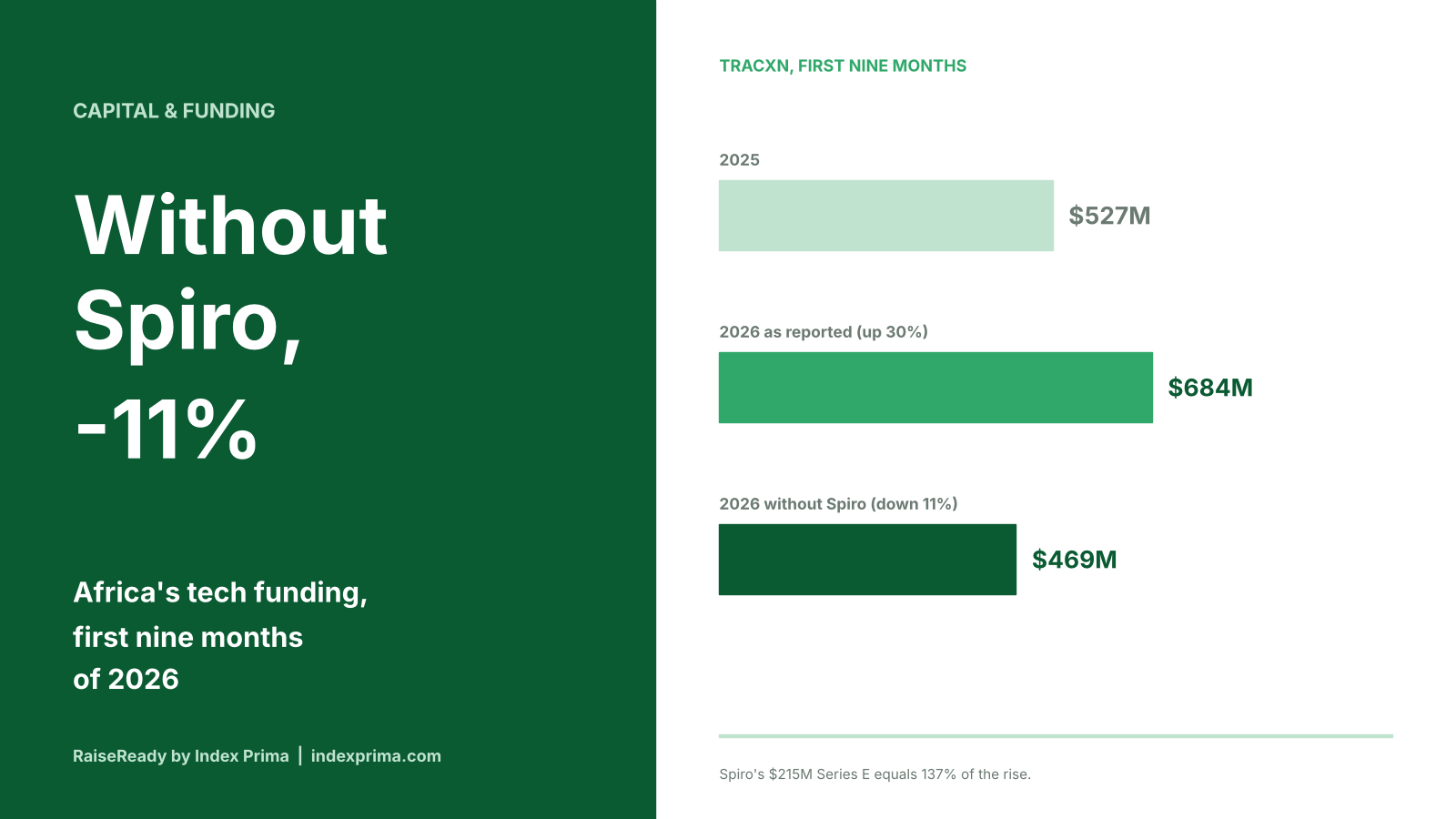
There is also a lesson about the numbers themselves. Tracxn’s 2025 base of $61 million for Nairobi excluded Spiro’s $100 million round, which came in October 2025, after the nine-month cut-off. So the comparison is lopsided. It sets a year without a mega-round against a year with one. The same is true for the whole continent. Tracxn says African funding is up 30%. Without Spiro, it is down 11%. A single deal turns a falling year into a rising one.
Finally, consider what Spiro’s raise says about the market. Investors will write very large cheques to African firms that look like infrastructure: batteries, vehicles, factories, networks. They are less willing to do so for a seed-stage app. Spiro’s backers include development finance and a Chinese growth fund. That pairing says something about where patient capital is coming from, and who it is willing to back. For African founders, the opportunity is to build businesses that look like infrastructure to investors, with recurring revenue, assets and clear unit economics. The risk is to chase a market that no longer exists in the seed stage.
Why it matters: City and country league tables shape where founders move, where investors look and where governments claim success. If one company can swing a city’s total by 354%, the table says more about accounting than about an ecosystem. The honest picture for Kenya is a strong asset-backed sector, a lumpy year and a seed stage under pressure. Founders should read funding reports the way they would read a pitch deck: ask who is in the number, what is excluded and which one deal moves it. Policymakers should watch the base, not the peak. A healthy ecosystem has many companies raising mid-sized rounds, not one raising a giant cheque.
What to watch next: whether Tracxn explains how it counts Spiro, since $215 million and $270 million cannot both be right. Watch the fourth quarter and the full-year figures from the trackers, which will show whether Kenya wins back first place from Egypt. Watch where Spiro spends its money, especially its launches in the Democratic Republic of Congo and Ethiopia, and how much of its growth still comes from Kenya. And watch the seed stage, where the count of ventures raising $100,000 or more is the number that tells you whether a new generation of Kenyan founders is getting funded.
Sources: Tracxn Africa Tech 9M 2026 report, via Forbes Africa; Business Daily on Kenya losing the top spot; Capital FM on Kenya’s Sh126B in 2025; Capital FM on Kenya’s first half of 2025; AU Startups on Kenya’s first half of 2026; Tech Africa on Spiro’s $270M round; TechCabal on Spiro’s $100M in October 2025; Independent Uganda on Spiro’s $215M; ThisDay on Spiro’s $55M from NewTrails.
A note for startup founders: Don’t practice on investors. Practice on AI first. RaiseReady by Index Prima is an AI fundraising simulator for African founders: upload your pitch deck, get a readiness score and face a tough AI investor before the real meeting. Find this post, and every post we publish, at raiseready.indexprima.com.