You rehearse your story for weeks. The investor has already decided what to look for, and most will never say it aloud. Here is what founders usually learn too late.
Investors across Africa say the same things in panels, interviews and guest posts, but they rarely say them to you in the room. Many pass with a polite “not a fit” and give no reason. This guide pulls together what African and global investors have said in public. It shows what they weigh, what makes them pause and how to prepare. None of it is a secret. Most founders just hear it after the meeting is over.
Start with the biggest one. The investor is often looking for reasons to say no. That sounds harsh, but it is how the job works. Taiwo Oluwo is a venture capital strategist. He says he has run due diligence on more than 50 deals since 2020. He told BridgeMena that African deal reviews tend to focus on “finding reasons not to invest.” The numbers elsewhere are tough too. Baukunst, a venture firm, told TechCrunch that it invests in roughly one of every 250 deals it sees. Only about one in 40 first meetings leads to a second. Baukunst also said most deals it studies fall apart in due diligence. The cause is usually something hard to fix, such as a weak team fit or a market that is too small. Treat the first meeting as a test of whether there is anything to fix at all.
Next, your deck often arrives before you do. Amara Uyanna of Schneider Electric told TechCabal that decks often reach investors before founders do. So they must make sense alone, with no one there to explain. A deck that needs a speaker to decode it may never earn a call. Uyanna also says that typos and mismatched numbers raise doubts about care. Read every slide twice, then ask a friend to read it cold.
Third, numbers need context. Steven Dossou, writing in Disrupt Africa in September, gives three plain examples. A 200% quarterly growth figure means little without the starting base. A $15 billion market needs a path to a real share, such as 1%. A $3 million raise needs a clear account of what the money unlocks. Jeffery Akemu of Launch Africa Ventures adds that a “$1 trillion” market claim with no research signals a weak grasp of the market. Samuel Frank of Sahara Impact Ventures wants to see how far a raise will take you. For example, can $1 million lift revenue from $100,000 to a much higher figure? Stumbling on a basic money question tells an investor something too. Dossou says it can suggest you do not know the business well enough to protect their capital.
Fourth, they are testing whether you know your own market. Akemu says a mortgage proptech is hard to build in Nigeria but easier in North and South Africa. He also points to capital limits in Ethiopia and remittance problems in Algeria. Investors notice when a founder copies a model from another region without checking the local rules, costs and habits. Claiming you have no competitors, they say, only suggests you have not looked.
Fifth, they think about the exit before they write a cheque. TechCabal reviewed 22 editions of its Ask an Investor series from the first half of 2026. It found that nearly every conversation came back to one question: how will the money be returned? Ido Sum, who spent 14 years as a partner at TLcom, argues that African venture capital “is not broken.” In his view the market is early and exits are slow. For you, this means a clear story about who might buy your company, or how it might list, is not a bonus. It is part of the pitch.
Sixth, your past matters, but the reason matters more. BusinessDay reported in December 2025 that African investors have long treated a shutdown as a disqualifier, partly because more than 60% of funds manage under $50 million. That is changing slowly. Investors now say failure is not automatic grounds for a no. But they dig into why it happened, how the company was run and what the unit economics looked like. Launch Base Africa data cited in the same report says 68.3% of founders who see a shutdown never start another company. If you have a failure behind you, say so early and say what you learned.
Seventh, investors read the label on your impact claims. An Intellecap article from 2022 describes a common move. Some founders pitch as a social enterprise when funding is on the table, even though impact is not central to the business. Investors see through it. In the same way, Muhammad Abubakar Usman of Consonance warns against terms like “AI-powered” with no explanation of what the AI actually does. Say what your product does, then show the proof.
Eighth, the pitch goes both ways. Dossou says the costliest mistake is walking in as if the pitch is one-way. He has seen the wrong investor sink companies the market wanted, because the relationship broke down, not because the money ran out. So ask questions. Ask how the fund supports companies after the cheque, whether it plans follow-on funding, and what went wrong in past deals. The same Intellecap piece says deal fatigue wears down both sides. It argues that a quick “no” is better than a long, drawn-out “yes.” If something feels off, you are free to walk away.
One more point is about fit. Intellecap’s research, from an event in 2022, found that 71% of founders wanted to raise under $1 million, yet only 38% of investors wrote tickets below that mark. Frank says he simply moves on when a deck does not match his thesis. So the best fix is homework. Study what each fund backs before you send a single email.
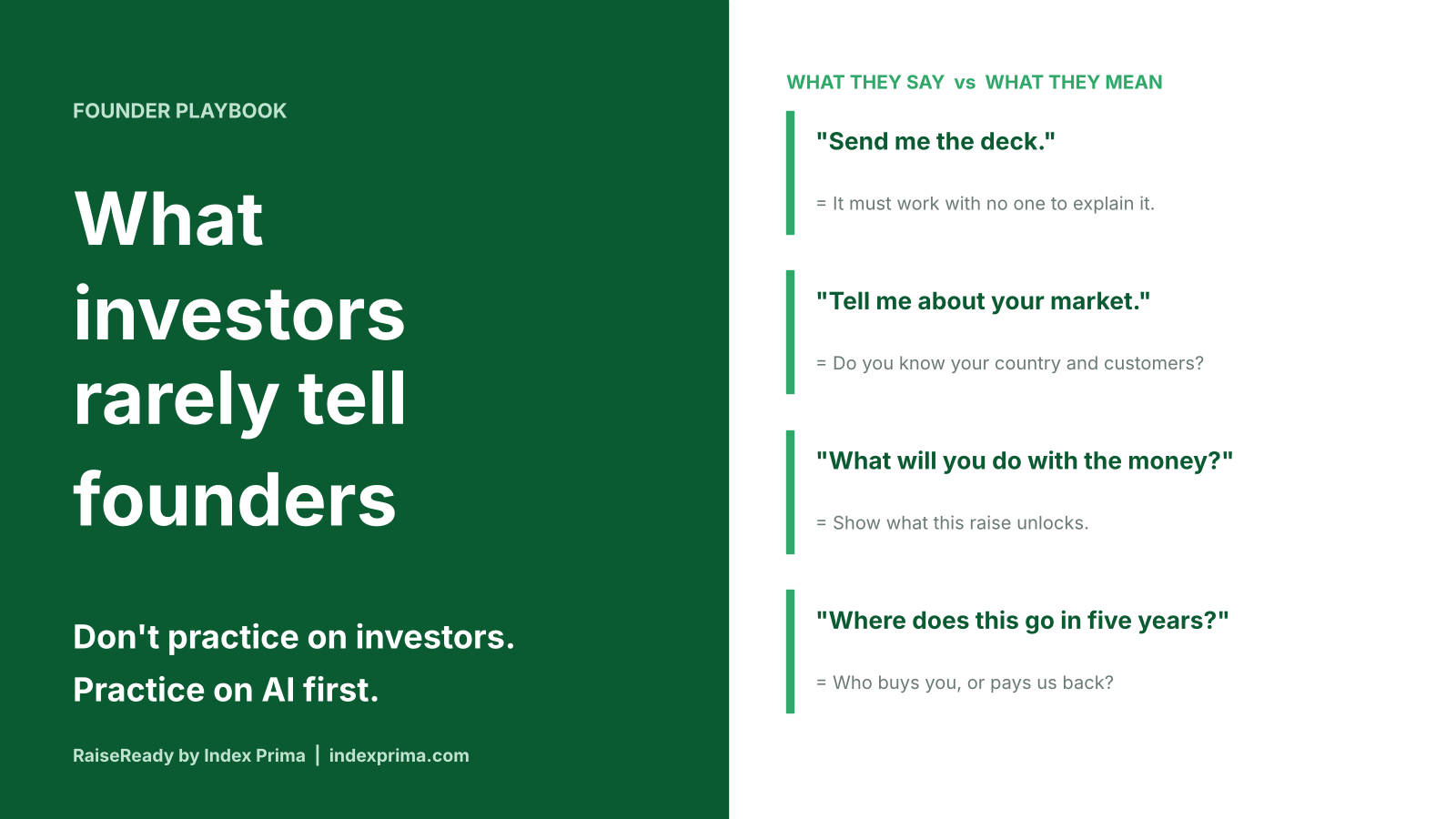
| What investors say | What they may mean |
|---|---|
| “Send me the deck.” | Your deck must work with no one to explain it. |
| “Tell me about your market.” | Do you know your country, rules and customers? |
| “What will you do with the money?” | Show what this raise unlocks, in numbers. |
| “Walk me through your numbers.” | Give the base, the source and the path. |
| “Where does this go in five years?” | Who buys you, or how do we get paid back? |
| “We will keep in touch.” | There may be a gap you did not fix. |
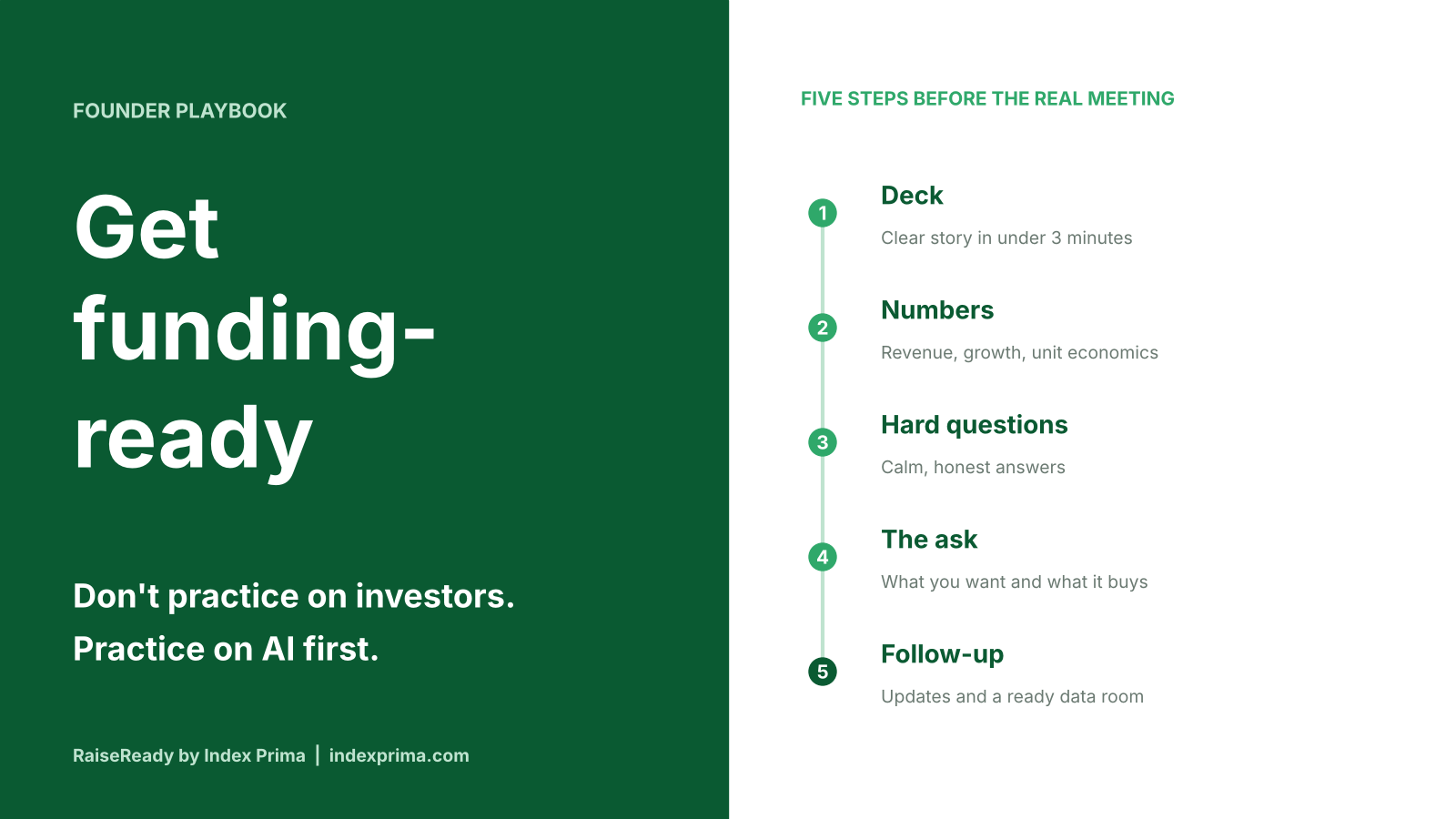
Practice is the cheapest cure. If you can answer these questions calmly before the meeting, you will spend the pitch room telling your story, not discovering your gaps.
Why it matters: Capital is not easy to win. Investors see many pitches, back few and rarely explain their reasons. Founders who understand the unspoken tests can fix gaps early, choose better-fit investors and walk into the room with clear answers. That saves months of effort.
What to watch next: whether more African funds publish clear criteria and give feedback on passes. Also watch how exits shape funding in 2027, and whether investors grow more open to founders with past failures.
Sources: Disrupt Africa, “What founders get wrong when they pitch investors and how to fix it,” by Steven Dossou; TechCabal, “What do African investors really look for in a pitch deck in 2025?”; TechCabal, “What 22 investors taught us so far in 2026”; TechCrunch on due diligence and early-stage deals; BusinessDay on failed founders re-entering the startup arena; BridgeMena on investor scrutiny of African startups; Intellecap on why early-stage deals fall through in Africa.
A note for startup founders: Don’t practice on investors. Practice on AI first. RaiseReady by Index Prima is an AI fundraising simulator for African founders: upload your pitch deck, get a readiness score and face a tough AI investor before the real meeting. Find this post, and every post we publish, at raiseready.indexprima.com.